


INTRODUCTION
Dental caries, also known as tooth decay, is a common but preventable oral disease that results from the gradual demineralization of dental hard tissues caused by an imbalance in the dental biofilm microbiome due to sugar consumption (Pitts et al., 2017; Silva et al., 2019). Well over 3 billion people worldwide suffer from it, and its distribution is uneven, particularly among those from lower socioeconomic backgrounds (Campus et al., 2020; Pitts et al., 2021; Schwendicke et al., 2015).
Streptococcus mutans is a facultative aerobic gram-positive bacterium that plays a crucial role in the formation of dental caries. It is a key causative factor of dental caries (Cong et al., 2019; Tinder et al., 2022; Zayed et al., 2021). Streptococcus mutans generates dental biofilm in conjunction with other biofilm-forming bacteria (Ito et al., 2020). It produces an extracellular enzyme, glucosyltransferase-B, which transforms glucan derived from sucrose found in dietary sources (Wang et al., 2020). Moreover, its lactic acid production significantly contributes to its status as a primary factor in tooth caries (Escano et al., 2016). It is also associated with systemic disorders and infections. (Metwalli et al., 2013; Nobbs, 2017).
Candida albicans is a prevalent opportunistic pathogenic yeast species found in the oral cavity. It is a major factor in oral candidiasis, which is a fungal infection that affects the oral mucosa. Research has demonstrated that Candida albicans is the predominant Candida species found in oral samples, comprising a significant fraction of the oral microbiota (Abrori, 2020; Garcia-Cuesta et al., 2014). This yeast can function as a commensal organism in the oral cavity, but, under specific conditions, such as immunosuppression or changes to the oral flora, it may convert into an opportunistic pathogen (Abrori, 2020). Research indicates that C. albicans is capable of forming biofilms autonomously as well as in association with other Candida species (Junqueira et al., 2011; Santos et al., 2016). C. albicans engages with other microbes in the oral cavity, including Streptococcus mutans, affecting biofilm development and pathogenicity (Bhardwaj et al., 2020). Moreover, the presence of C. albicans in biofilms has been associated with dental caries and oral infections, making it important to understand its biofilm-forming abilities. C. albicans infections are not limited to the oral cavity; they can potentially result in systemic infections in immunocompromised patients (Mokhtar et al., 2021).
Since these oral pathogens play a significant role in the development and progression of oral diseases, impacting both oral health and potentially contributing to systemic conditions, it is critical to create effective antimicrobials against them. Furthermore, to prevent multi-resistant microorganisms and the negative effects of conventional antimicrobials, the scientific literature advocates the development of natural therapies for dental biofilm bacteria rather than the routine administration of systemic and conventional antimicrobials (Lu et al., 2019) Natural herbal plants containing significant bioactive compounds can be employed to overcome the development of multiresistant and virulent bacteria in dental biofilms (Lu et al., 2019). In addition to being less expensive, these natural products are comparatively safer.
Rosa damascena, commonly known as the Arab rose (AR), is renowned for its aromatic properties and extensive pharmacological uses. This flowering plant from the Rosaceae family is rich in bioactive compounds, such as flavonoids, terpenes, and essential oils, which contribute to its medicinal properties. Research has indicated that AR flower extracts exhibit antioxidant and antibacterial activities (Özkan et al., 2004). Studies have indicated that the extracts can reduce blood glucose levels, possibly by inhibiting alpha-glucosidase activity.(Padam et al., 2020) Flavonoids and glycoside compounds contribute to this hypoglycemic effect by improving insulin sensitivity (Padam et al., 2020). AR also exhibits significant antioxidant properties. The plant contains phenolic compounds that lower oxidative stress and efficiently scavenge free radicals (Akram et al., 2020)..AR has been demonstrated to relax airway muscles, suggesting possible therapeutic applications in asthma and other respiratory conditions. These antioxidant effects have also been noted in the respiratory system (Boskabady et al., 2006). Additionally, studies indicate that AR has a positive impact on liver function, particularly in conditions such as non-alcoholic fatty liver disease, where it helps normalize liver enzyme levels (Davoodi et al., 2017; Moravej et al., 2021).
The anti-inflammatory properties of AR further enhance its therapeutic potential. Furthermore, these anti-inflammatory effects may contribute to its analgesic properties, providing relief in various pain conditions (Bani et al., 2014). Recent findings reveal its potential applications in neurological health, particularly in enhancing memory and learning by providing neuroprotective effects against oxidative damage (Karimi et al., 2021). Furthermore, the antimicrobial properties of AR have expanded its applications in oral health, demonstrating effectiveness against dental plaque formation and biofilm inhibition (Professor & Head in Pediatric and Preventive Dentistry, Group Leader, Special research group-Dental Cariology, JSS Dental College and Hospital, Mysore, India & Nandlal, 2023). Ghavam et al. noted that compounds such as geraniol and citronellol, prevalent in the essential oil, significantly contribute to its antimicrobial activity. Their study indicated that variations in the chemical composition of essential oils from different geographic areas affect their efficacy, which emphasizes the complexity of AR’s antibacterial properties.(Ghavam et al., 2021) Furthermore, Yang et al. characterized the presence of gallic acid, among other compounds, in AR, which is known for its broad antimicrobial effects, including inhibiting pathogenic bacteria such as Staphylococcus aureus.(Yang et al., 2022) Batool et al. highlighted the antilisterial activity of AR, emphasizing its potential against Listeria monocytogenes, which underlines its efficacy against a range of Gram-positive bacteria and suggests possible applications in food safety and preservation (Batool et al., 2018). Thus, AR represents a strong case for further research into its antibacterial applications due to its potent antimicrobial activity, diverse chemical composition, and the growing need for alternatives to conventional antibiotics.
Numerous studies have been interested in AR’s antibacterial properties, especially when it comes to flower extracts and essential oils. The plant is a valuable natural resource with potential uses in antimicrobial therapies because of its varied bioactive compounds, which also contribute to its antibacterial qualities. Thus, the purpose of this study was to identify and quantify the compounds present in AR extract and examine the antibacterial, antifungal, and anti-adherence qualities against Candida albicans and Streptococcus mutans.
2. MATERIALS AND METHODS
2.1. Procurement and extraction of Rosa damascena33
AR flower samples were gathered from a farmhouse at Tamil Nadu Agricultural University, Coimbatore, India, with the following latitude and longitude coordinates: 11.012233826819873, 76.93539163640915. The flower powders were solvent-extracted (ethanol and methanol) using a Soxhlet extraction apparatus. The collected extracts were transferred to individual Petri dishes, oven-dried at 50°C, scraped, and kept in airtight containers at room temperature.
2.2. Procurement of test bacteria
Test organisms that were highly significant and had etiological traits linked to dental disease were chosen for the investigation. The selected microbial strains included Streptococcus mutans (ATCC 25175) and Candida albicans (ATCC 10231).
2.3. Antimicrobial activity of Rosa damascena (Anita et al., 2014)
The antimicrobial efficacy of AR extracts was evaluated against test organisms (Streptococcus mutans and Candida albicans) using the well diffusion method. All test cultures were inoculated in sterile nutrient broth (g/L) that contained peptone (5 g), yeast extract (5 g), beef extract (3 g), and sodium chloride (5 g), with a final pH of 7.0 ± 0.2. The cultures were then left to grow for 24 to 48 hours. After preparing sterile Mueller-Hinton Agar (MHA) plates, they were left to set. The test organism’s 0.1% inoculum suspensions were evenly distributed across the agar surface in each case using swabs. On the agar surface of every plate, five wells, each of six-millimetre diameter, were aseptically made. The first well received 300 µg/ml of ethanol extract (E1), the second well received 400 µg/ml of ethanol extract (E2), the third well received 300 µg/ml of methanol extract (M1), the fourth well received 400 µg/ml of methanol extract (M2), and the fifth well received 4 µg/ml of streptomycin (S) as the positive reference. Following the incubation period of 24 hours at 37°C, the presence of significant inhibitory zones was noted.
2.4. Determination of minimum inhibitory concentration (MIC) of Rosa damascena (Al-Madi et al., 2019)
To determine the MIC of the test organisms, a series of five Mueller-Hinton broth tubes was prepared under sterile conditions for each organism. About 100 μl of extracted AR was added to Mueller–Hinton broth tubes at various concentrations (100, 200, 300, 400, and 500 µg/ml). After adding roughly 10 μl of the test culture suspension to the broth, the broth was observed for the development of turbidity. All of the tubes underwent aerobic and anaerobic incubation for 24 hours at 37°C. The minimum dilution that inhibited the development of the test organism was designated as the MIC of AR.
The minimal bactericidal/fungicidal concentration of the AR extracts was ascertained by inoculating MHA plates with a loopful of sample collected from the corresponding organism’s designated MIC tube (composition g/L: acid hydrolysate of casein: 17.5 g; starch: 1.5 g; sodium chloride: 5.0 g; agar: 17.0 g; final pH – 7.0 ± 0.2). The plates were incubated, and the growth of microorganisms was observed. The absence of microbial growth was used to determine the minimal bactericidal concentration (MBC) and minimal fungicidal concentration (MFC) of the selected AR extracts.
2.5. Anti-adherent activity of Rosa damascena (Brandão et al., 2007)
Nine millilitres of each AR extract were added to test tubes containing 0.37 grams of dehydrated culture medium (BHI broth with 10% sucrose). Subsequently, standardised glass specimens (diameter: 2 mm; length: 5 cm) were introduced into the tubes and subjected to autoclave sterilisation. Each tube was filled with 1 ml of 24-hour test cultures (Candida albicans and Streptococcus mutans) and incubated for 90 minutes at 37°C to evaluate bacterial adherence. After incubation, the glass samples were moved to tubes filled with phosphate-buffered saline (pH 7.2). For distilled water, an analogous experimental design was employed. Rather than employing the AR extract, samples were placed into a different set of tubes containing distilled water. After shaking each tube, 10-1 and 10-4 dilutions were made from the original suspension in sterile NaCl (0.85%) saline solution. BHI agar was then inoculated with 0.1 ml aliquots of each dilution, and the mixture was incubated for 48 hours at 37°C. Following this time frame, the colonies were counted and the log CFU/ml value was calculated.
2.6. Gas chromatography–mass spectrometry (GC–MS) analysis of Rosa damascena (Sivaraj, 2019)
An Agilent Technologies 6890N JEOL GC Mate II GC-MS device equipped with an HP-5 column was loaded with a methanol extract of fresh AR powder. The chromatographic parameters utilised were as follows: the column oven temperature ranged from 50 to 250°C with an injection rate of 10°C/min, the injector was run at 200°C, and the carrier gas was helium at a flow rate of 1 mL/min. An ionisation voltage of 70 eV, an ion source temperature of 250°C, an interface temperature of 250°C, and a mass range of 50–600 mass units were among the mass spectrometry parameters used. The GC-MS mass spectrum was examined using the National Institute of Standards and Technology library, which has about 62,000 patterns.
3. RESULTS
3.1. Antimicrobial activity of Rosa damascena
The standard agar diffusion method was used to evaluate the bactericidal efficacy of AR’s ethanol and methanol extracts. The examination revealed no inhibitory zones for the ethanol extract at a dosage of 300 µg/ml against either of the test cultures (Table 1). When tested with an ethanol extract at a concentration of 400 µg/ml, the Streptococcus mutans sample showed inhibitory zones of approximately 9.3 ± 1.05 mm. Both 300 µg/ml and 400 µg/ml methanol extract concentrations demonstrated inhibitory zones against Streptococcus mutans of 12.6 ± 0.75 mm and 15.9 ± 0.57 mm (Figure 1A).
Table 1
Antibacterial activity of Rosa damascena extracts against test organisms.
| S. no. | Test organism | Zone of inhibition (millimetre) | |||||
|---|---|---|---|---|---|---|---|
| E1 | E2 | M1 | M2 | S | |||
| 1 | Streptococcus mutans | 0 ± 0.0 | 9.3 ± 1.05 | 12.6 ± 0.75 | 15.9 ± 0.57 | 18.9 ± 0.75 | |
| 2 | Candida albicans | 0 ± 0.0 | 10.3 ± 1.05 | 12.9 ± 0.57 | 15.6 ± 0.75 | 19.3 ± 1.25 | |
Figure 1
Antibacterial activity of Rosa damascena extracts (A) Streptococcus mutans, (B) Candida albicans.
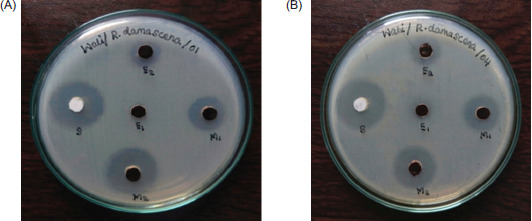
Candida albicans showed inhibitory zones of approximately 10.3 ± 1.05 mm at 400 µg/ml of ethanol extract. Both 300 µg/ml and 400 µg/ml methanol extract concentrations demonstrated inhibitory zones against Candida albicans of 12.9 ± 0.57 mm and 15.6 ± 0.75 mm (Figure 1B). The acquired data were simultaneously compared with those of the standard antibiotic streptomycin to validate its antimicrobial efficacy. The ethanol extracts of AR showed slightly less efficacy than the standard antibiotic, indicating that a higher dose is required to achieve a similar inhibitory zone size. The highest activity against the tested pathogens was demonstrated by methanol AR extracts among the ethanol and methanol extracts.
3.2. MIC of Rosa damascena extracts
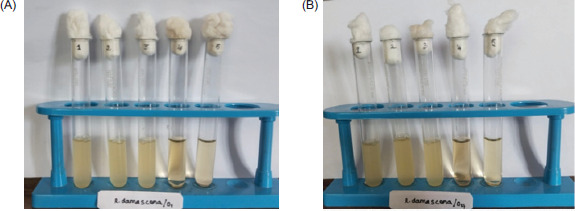
The present study used the micro broth dilution method to determine the minimal inhibitory concentration (MIC) of the AR methanol extract against the test organisms at various concentrations (100, 200, 300, 400, and 500 µg/ml). Using the broth dilution method, the test cultures (Candida albicans and Streptococcus mutans) showed turbidity at the first three concentrations of 100 µg/ml, 200 µg/ml, and 300 µg/ml; however, no growth was noted at 400 µg/ml and 500 µg/ml. Therefore, 400 µg/ml of AR extracts was the minimum inhibitory concentration for Streptococcus mutans and Candida albicans (Table 2, Figure 2A, and Figure 2B).
3.3. Anti-adherence activity of Rosa damascena
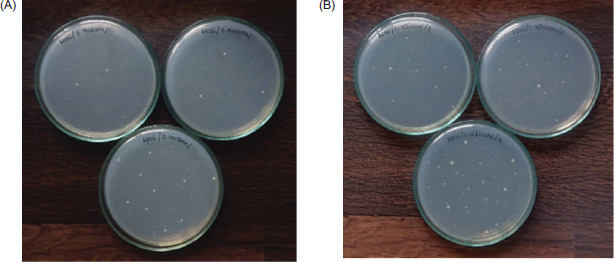
The methanol extract of AR decreased the number of organisms adhering to the glass specimens, according to the results of the anti-adherence test. However, compared to the extract-exposed samples, the samples exposed to distilled water displayed more bacterial colonies on BHI agar plates. Figures 3A and 3B (Streptococcus mutans and Candida albicans) show the figures for each test culture, which demonstrate this conclusion.
Figure 3
. (A) Number of colonies observed on BHI agar plates (Streptococcus mutans) Trial - 1, Trial 2 (top plates), Distilled water (bottom plate), (B) Number of colonies observed on BHI agar plates (Candida albicans), Trial - 1, Trial 2 (top plates), Distilled water (bottom plate).
Following 90 minutes of contact between Streptococcus mutans and other test cultures and test solutions, the log CFU/ml for each experimental group was computed and is shown below. While the cultures exposed to distilled water displayed more colonies of roughly 8.4 × 10⁴ CFU/ml, Trials 1 and 2 against Streptococcus mutans yielded 2.6 × 10⁴ CFU/ml and 3.1 × 10⁴ CFU/ml, respectively (Figure 4A). Comparably, Trials 1 and 2 against Candida albicans revealed 3.5 × 10⁴ CFU/ml and 3.9 × 10⁴ CFU/ml, respectively. More colonies of roughly 8.6 × 10⁴ CFU/ml were seen in the cultures exposed to distilled water (Figure 4B).
Figure 4
(A) Mean (log of CFU/ml) obtained in the analysis of bacterial adherence to glass (Streptococcus mutans). (B) Mean (log of CFU/ml) obtained in the analysis of bacterial adherence to glass (Candida albicans).
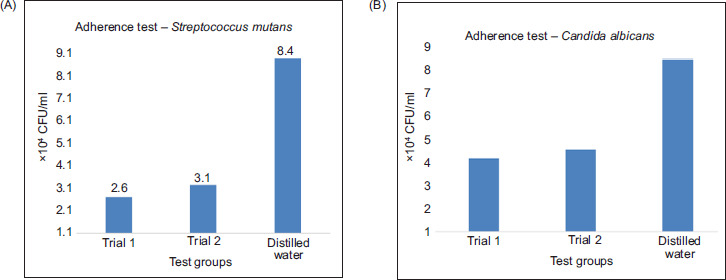
The obtained CFU/ml values for distilled water and the samples against both test organisms showed that the methanol extract of AR considerably reduced the adherence of organisms on the surface of the glass specimen.
3.4. GC-MS analysis of Rosa damascena
GC-MS analysis of the methanol extract of AR detected the presence of various bioactive compounds, which primarily contributed to the antibacterial and antifungal activities. GC-MS analysis of AR, revealing the retention time values corresponding to the significant compounds, is presented in Figure 5.
During the GC-MS analysis of the AR extracts, ten major peaks were evident in the spectrum (Figure 5). Table 3 displays the significant peaks along with their molecular weights, retention times, and formulas.
Table 3
Biological compounds in AR extracts.
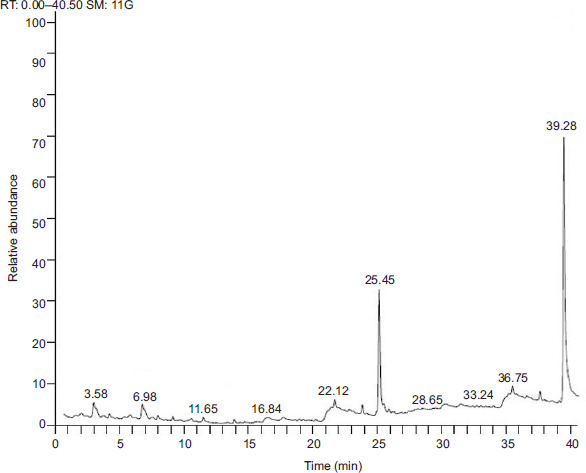
Three significant compounds, methyl butanol, phytol, and cedrol, were attributed to antifungal activity, with retention time peaks at 3.58, 25.45, and 33.24. Whereas methyl butanol, citronellyl butyrate, octadecane, quinoxaline, phytol, dimethyl hexacosane, 9,12-octadecadienoic acid, and eicosane were attributed to antibacterial activity, with retention time peaks at 3.58, 6.98, 11.65, 22.12, 25.45, 28.65, 36.75, and 39.28, respectively.
4. DISCUSSION
Dental caries, commonly known as tooth decay, is caused by Streptococcus mutans, the primary etiological agent (Cong et al., 2019; Tinder et al., 2022; Zayed et al., 2021). It can produce dental biofilms and become resistant to present-day antibiotics. Another commonly found opportunistic pathogenic yeast species is Candida albicans, which also has the ability to interact with microorganisms such as Streptococcus and influence biofilm formation (Bhardwaj et al., 2020). Therefore, both organisms were selected as test organisms in the present study. The renowned scientist Ibn Sina first used the essential oil of AR in the 10th century to treat various ailments. Rose water is traditionally used as an antiseptic agent for eye washing and mouth disinfecting (Gochev et al., 2008). Therefore, AR was used in the present study to determine whether it had any effect on caries-causing bacteria.
In the present study, methanol extract concentrations of both 300 and 400 µg/ml showed inhibitory zones of 12.6 ± 0.75 mm and 15.9 ± 0.57 mm against Streptococcus mutans. These results are consistent with those found by Junita et al., who reported that a 5% Red Rose ethanol extract effectively inhibited Streptococcus mutans with an inhibition zone of 21.4 mm (Junita et al., 2020). However, the Bahasa language in this article makes it difficult for English readers to access this research. Ghavam et al. demonstrated that essential oils from AR exhibited antimicrobial effects against Streptococcus pyogenes bacterial strains. Streptococcus pyogenes are from different subspecies of bacteria, but they all belong to the same species as the test organism and can be considered supportive for the present study (Ghavam et al., 2021).
Similarly, inhibitory zones of 12.9 ± 0.57 mm and 15.6 ± 0.75 mm against Candida albicans were observed in the current study at methanol extract concentrations of 300 µg/ml and 400 µg/ml. Lee et al. found that 1% Bulgarian AR oil effectively inhibited Candida albicans with an inhibition zone of 13.5 mm, which is in line with the present study findings (Lee et al., 2023). However, in one of the recent studies, it was shown that ethyl acetate extract of AR showed no activity against Candida albicans, although it displayed significant activity against Propionibacterium acnes, Staphylococcus aureus, and S. epidermidis (Trendafilova et al., 2023). The variation in the results may be attributed to differences in the extraction methods or variations in bioactive plant compounds due to the geolocation where the plant is grown.
The anti-adherent activity of Streptococcus mutans and Candida albicans test organisms exposed to AR was evaluated in two trials, and the results indicated that the number of CFU/ml was significantly lower in both trials compared to cultures exposed to distilled water. Since this was the first study, to our knowledge, to check the antiadherent activity of AR against the test organisms, there were no other studies to compare the results. However, antiadherence activity was checked for Porphyromonas gingivalis and Aggregatibacter actinomycetemcomitans by Peeran et al., who confirmed that AR plays a critical role in the modulation of oral microbial adherence and biofilm formation (Peeran et al., 2024).
The antibacterial, antifungal, and antiadherent findings can be attributed to the various phytochemicals found in the GC-MS analysis of AR in this study, including methyl butanol, quinoxaline, phytol, cedrol, citronellyl butyrate, octadecane, hexadecanoic acid, dimethyl hexacosane, 9,12-octadecanoic acid, and eicosane, in accordance with the National Institute of Standards and Technology library. Yang et al. (2022) along with other phytochemicals, described the presence of gallic acid also in the ethyl acetate extract of AR, which is well known for its wide range of antimicrobial properties, including the inhibition of harmful bacteria such as Staphylococcus aureus (Yang et al., 2022). However, in the present study, gallic acid was not found, and this could be because a methanol extract of AR was used for GC-MS analysis rather than an ethyl acetate extract. Initially, antibacterial and antifungal activity was conducted against ethanol and methanol extracts of AR; however, GC-MS analyses were conducted for methanol extracts only because they showed better antimicrobial activity than ethanol extracts.
The study’s strengths include being the first to test the antiadherent action of AR, while its weaknesses include the fact that only methanol extract was used for GC-MS analysis. GC-MS analysis can be performed with different extracts in future research to check for the presence of other phytochemicals. Molecular docking studies are necessary to comprehend molecular interactions. Furthermore, the antibacterial properties of the components can be contrasted with those of antibiotics like chlorhexidine, a widely recognized standard among oral mouth rinses. It is also important to assess the extract’s safety profile, particularly its cytotoxicity, and determine whether it can be used therapeutically to treat dental caries.
5. CONCLUSION
Rosa damascena, also referred to as the Arab rose, has been shown to contain a variety of biological compounds that influence its antibacterial, antifungal, antioxidant, and anti-biofilm qualities. The current study examined the antimicrobial and anti-adherent properties of flower solvent extracts against two important dental disease-causing microorganisms. To the best of the authors’ knowledge, this present study conducted antiadherence testing of AR extracts for the first time against Streptococcus mutans and Candida albicans, and the results were positive. Moreover, the antimicrobial activity of AR extracts found in this study was in concurrence with earlier studies, showing that AR is a significant natural resource with potential applications as a natural additive in herbal biofilm-inhibitory oral hygiene products.
ACKNOWLEDGEMENT
The authors would like to thank the Gram-Positive Laboratory, Tamil Nadu, India, for their assistance with microbiological laboratory work.
AUTHORS’ CONTRIBUTION
All authors listed have made substantial, direct, and intellectual contributions to the work and approved it for publication.
FUNDING
This research received no specific grants from any funding agency in the public, commercial or not-for-profit sectors.

