About the Journal
Editorial Board
Editorial Office and Publisher
Ownership
Article Processing Charge
Open Access and Licensing
Personal Data Protection
Terms and Conditions: Cookie policy and Privacy policy
Copyright and Copyright Transfer Agreement
Visagaa Publishing House Repository Policy
Visagaa Publishing House CrossMark Policy
The Initiative for Open Citations (I4OC)
Archiving
Plagiarism Policy
Online first
Current issue
Archive
Ethics Statements for Natural Resources for Human Health
Ethical Guidelines
Post-Publication Policies
Responsibilities of Editors and Publishers
Conflict of Interest Statements for Natural Resources for Human Health
Human and Animal Rights Policy
Complaints and Appeals Policy
Allegations of Research Misconduct Policy
Authorship and Contributorship Policy
Publication Ethics and Malpractice Policy
Ethics approval and informed consent
Guidelines for the Use of Generative AI and AI-Assisted Technologies in Manuscripts for Natural Resources for Human Health
For authors
Instructions for Authors
Submitting manuscript – step by step
Authorship and Contributor Guidelines
For reviewers
The peer-review process
Recognition for Reviewers
Visagaa Author Services
About the Journal
Editorial Board
Editorial Office and Publisher
Ownership
Article Processing Charge
Open Access and Licensing
Personal Data Protection
Terms and Conditions: Cookie policy and Privacy policy
Copyright and Copyright Transfer Agreement
Visagaa Publishing House Repository Policy
Visagaa Publishing House CrossMark Policy
The Initiative for Open Citations (I4OC)
Archiving
Plagiarism Policy
Ethics Statements for Natural Resources for Human Health
Ethical Guidelines
Post-Publication Policies
Responsibilities of Editors and Publishers
Conflict of Interest Statements for Natural Resources for Human Health
Human and Animal Rights Policy
Complaints and Appeals Policy
Allegations of Research Misconduct Policy
Authorship and Contributorship Policy
Publication Ethics and Malpractice Policy
Ethics approval and informed consent
Guidelines for the Use of Generative AI and AI-Assisted Technologies in Manuscripts for Natural Resources for Human Health

| eISSN: | 2583-1194 |

REVIEW PAPER
Syzygium jambos (L.) Alston (Rose Apple): A Review of its Phytochemistry and Pharmacology
1
Departamento de Bioquímica, Universidad Nacional de Trujillo, Peru
2
Departamento de Ciencias Químicas, Universidad Nacional Agraria de la Selva, Peru
3
Hospital Alta Complejidad “Virgen de la Puerta”, EsSalud, Peru
4
Facultad de Ciencias de la Salud, Universidad Privada del Norte, Peru
5
Laboratório de Tecnologia em Produtos Naturais, Universidade Federal Fluminense, Brazil
Submission date: 2025-10-22
Final revision date: 2025-10-28
Acceptance date: 2026-01-25
Online publication date: 2026-06-30
Corresponding author
Ricardo Diego D.G. de Albuquerque
Laboratório de Tecnologia em Produtos Naturais, Universidade Federal Fluminense, Brazil
Laboratório de Tecnologia em Produtos Naturais, Universidade Federal Fluminense, Brazil

KEYWORDS
TOPICS
ABSTRACT
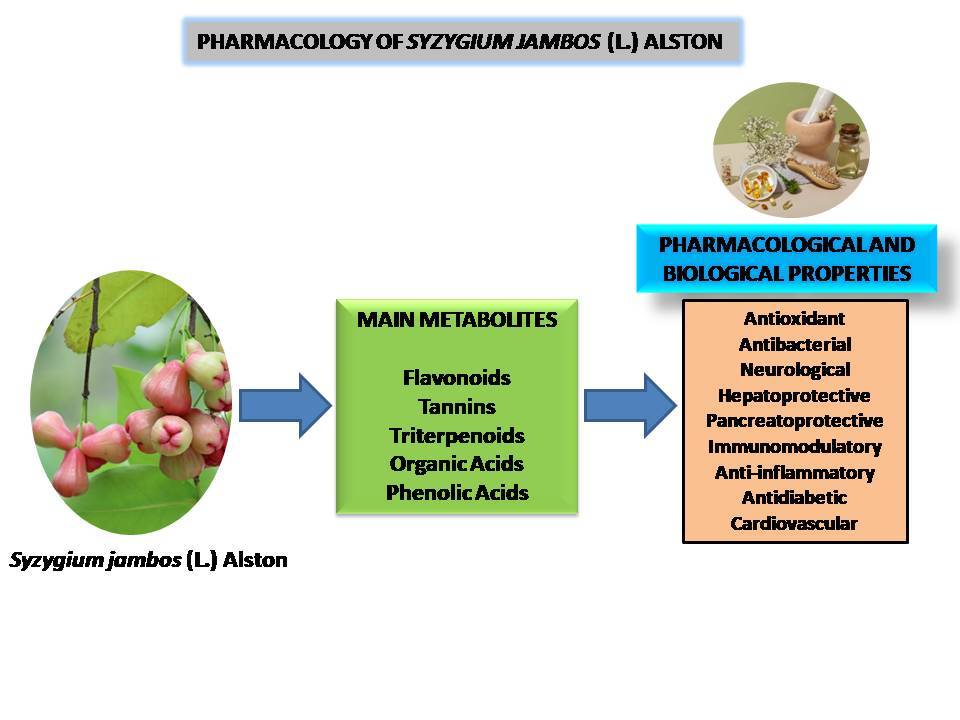
Syzygium jambos L. Alston (Myrtaceae), commonly known as “pomarrosa”, “jambolero”, “rose apple”, “yambo”, among others, is a wild species found in Asia and America. It grows on the western slopes of northern Peru in rocky or stony and moderately sub-xerophytic environments at altitudes ranging from 1,500 to 2,200 meters above sea level. The objective of this review is to compile scientific information on S. jambos, focusing on its phytochemistry as a potential source of novel bioactive compounds and its therapeutic applications. The literature search was conducted using electronic databases such as Scopus, ScienceDirect, PubMed Central, and the Google Scholar search engine. A total of 33 documents in English and Spanish were selected. A bibliographic review of S. jambos reveals that this plant species is rarely utilized in traditional medicine. However, further research is required to explore its phytochemistry as a potential source of novel bioactive compounds, as well as its pharmacological properties, contemporary applications, and toxicological profile with scientific validation. The collected data indicate its efficacy in various in vitro and in vivo pharmacological activities, including antimicrobial, antiviral, anti-inflammatory, antimutagenic, antinociceptive, antipyretic, antispasmodic, antithrombotic, apoptotic, cardiovascular, chemomodulatory,
antitumor, hepatoprotective, hypoglycemic, hypolipidemic, and memory-enhancing effects. Despite the diversity of pharmacological
activities of S. jambos, further studies on clinical assays and the development of formulations must be carried out. Hence, S. jambos has emerged as a valuable source in traditional medicine and provides a significant foundation in pharmaceutical biology for the development and formulation of new drugs and future clinical applications.
REFERENCES (40)
1.
Amir Rawa, M.S., Nurul Azman, N.A., Mohamad, S., Nogawa, T., & Wahab, H.A. (2022). In vitro and in silico anti-acetylcholines-terase activity from Macaranga tanarius and Syzygium jambos. Molecules, 27, 2648. https://doi.org/10.3390/molecu....
2.
Apaza Ticona, L., Souto Pérez, B., Martín Alejano, V., & Slowing, K. (2021). Anti-inflammatory and anti-arthritic activities of glycosylated flavonoids from Syzygium jambos in edematogenic agent-induced paw edema in mice. Revista Brasileira de Farmacognosia,31, 429–441. https://doi.org/10.1007/s43450....
3.
Ávila-Peña, D., Peña, N., Quintero, L., & Suárez-Roca, H. (2007). Antinociceptive activity of Syzygium jambosleaves extract in rats. Journal of Ethnopharmacology,112, 380–385. https://doi.org/10.1016/j.jep.....
4.
Bartra Vasquez, G.L. (2019). Aprovechamiento del contenido nutricional de la fruta de pomarrosa (Syzyguin jambos (L.) Alston) con pulpa de Camu (Myrciaria dubia H.B.K. Mc Vaugh) como fuente de vitamina C, en la elaboración de mermeladas- Pucallpa. Bachelor’s Thesis,Universidad Nacional de Ucayali, Peru.
5.
Bonfanti-Azzolin, G., Leal Zambra, A., Morgan da Silva, B., Santos De Bona, K., Eliete Rodrigues Bitencourt, P., Cargnelutti, L., Maleski Borges, R., De Freitas, M.L., Brandão, R., Woutheres Bortolotto, J., Augusti Boligon, A., Pigatto, A.S., Moretto, M.B., & de Lima Gonçalves, T. (2019).Toxicity assessment of Syzygium jambos and Solanum guaraniticum hydroethanolic leaf extracts thru Artemia salina lethality and spleen lymphocyte cytotoxicity tests. International Journal of Innovation Education and Research, 7, 133–143. https://doi.org/10.31686/ijier....
6.
Borges, L.L., Alves, S.F., Sampaio, B.L., Conceição, E.C., Bara, M.T.F., & Paula, J.R. (2013).Environmental factors affecting the concentration of phenolic compounds in Myrcia tomentosa leaves. Revista Brasileira de Farmacognosia, 23, 230–238. https://doi.org/10.1590/S0102-....
7.
Cartaya, O. (2001). Reseña bibliográfica flavonoides: características químicas y aplicaciones. Cultivos Tropicales, 22, 5–14.
8.
Cock, I.E., & Cheesman, M. (2009). The potential of plants of the genus Syzygium (Myrtaceae) for the prevention and treatment of arthritic and autoimmune diseases. InBioactive food as dietary interventions for arthritis and related inflammatory diseases (pp. 401–424). Elsevier, Amsterdam, Netherlands. https://doi. org/10.1016/B978-0-12-813820-5.00023-4.
9.
Djipa, C.D., Delmée, M., & Quetin-Leclercq, J. (2000). Antimicrobial activity of bark extracts of Syzygium jambos (L.) Alston (Myrtaceae).Journal of Ethnopharmacology,71, 307–313. https://doi.org/10.4000/books.....
10.
Dutta, S., Halder, S., & Khaled, K.L. (2023). Phytochemical investigation and in vitro antioxidant activity of Syzygium jambos fruit and its seed. Asian Journal of Pharmaceutical and Clinical Research, 16, 35–40. https://doi.org/10.22159/ajpcr.... v16i2.46496.
11.
Filian Murrieta, A., & Velásquez, J. (2017). Desarrollo de una compota a base de pomarrosa (Syzygium malaccense L.), fortificada con harina de amaranto (Amaranthus caudatus L.). Bachelor’s Thesis, Universidad Católica de Santiago de Guayaquil, Ecuador. Gonzáles-Blas, M.V., García-Armas, J.M., & Herrera-Gutiérrez, L.A. (2022). Flavonoides y fenoles totales con actividad hipoglicemiante en semillas de Syzygium jambos. Revista Salud Amazónicay Bienestar, 1, e272–e272.
12.
Growables. (2021). Rose apple - Syzygium jambos. https://www. growables.org/information/TropicalFruit/RoseApple.htm (accessed May 5, 2025).
13.
Inostroza-Nieves, Y., Valentin-Berrios, S., Vega, C., Prado, G.N., Luciano-Montalvo, C., Romero, J.R., & Rivera, A. (2022). Inhibitory effects of Syzygium jambos extract on biomarkers of endothelial cell activation. BMC Complementary Medicine and Therapies, 22, 101. https://doi.org/10.1186/s12906....
14.
Khan, M.K., Anjum, F.M., Arshad, M.U., & Hassan, S. (2015). Eugenia jambos. RPMP, 45, 1–33.
15.
León Lincango, J. (2015).Estudio investigativo de la pomarrosa y su aplicación en la gastronomía. Bachelor’s Thesis, Universidad Tecnológica Equinoccial, Ecuador.
16.
Liu, J., Chen, X., Zeng, H., Wang, S., &Xiang, L. (2022). Optimization of the extraction process of triterpenoids from the seeds of Syzygium jambos L. Alston by response surface methodology and its antioxidant activity. Science and Technology of Food Industry, 43, 192–199. https://doi.org/10.13386/j.iss....
17.
López-Vergara, I., & Ortega, C. (2022).Evaluación de la actividad antioxidante de la pomarrosa (Syzygium malaccense) en condi-ciones de congelación a 0°c, -10°c y -20°c. Bachelor’s Thesis, Universidad De Guayaquil, Ecuador.
18.
Mahmoud, M.F., Abdelaal, S., Mohammed, H.O., El-Shazly, A.M., Daoud, R., El Raey, M.A., &Sobeh, M. (2021). Syzygium jambos extract mitigates pancreatic oxidative stress, inflammation and apoptosis and modulates hepatic IRS-2/AKT/GLUT4 signaling pathway in streptozotocin-induced diabetic rats. Biomedicine and Pharmacotherapy, 142, 112085. https://doi.org/10.1016/j.biop....
19.
Manaharan, T., Appleton, D., Cheng, H., & Palanisamy, U. (2012). Flavonoids isolated from Syzygium aqueum leaf extract as poten-tial antihyperglycaemic agents. Food Chemistry, 132, 1802–1807. https://doi.org/10.1016/j.food....
20.
Mayhuasque Hernández, C. (2015). Mermelada de Syzygium malac-cences pomarrosa, enriquecida con camuMyrciaria dubia H.B.K. Mc Vaugh. Bachelor’s Thesis,Universidad Nacional De Ucayali, Peru.
21.
Pandita, D., Pandita, A., & Bhanu, C. (2022). Antidiabetic plants for drug discovery (Vol. 1). Apple Academic Press, Palm Bay, United States. https://doi.org/10.1201/978100....
22.
Park, K., Chong, Y., & Kim, M. (2016). Myricetin: Biological activity related to human health. Applied Biological Chemistry, 59, 259–269. https://doi.org/10.1007/s13765....
23.
Parmar, J., Sharma, P., Verma, P., & Goyal, P.K. (2011). Modulation of DMBA-induced biochemical and histopathological changes by Syzygium cumini seed extract during skin carcinogenesis. International Journal of Current Biomedical and Pharmaceutical Research,1, 24–30.
24.
Rajkumari, J., Borkotoky, S., Murali, A., & Busi, S. (2018a). Anti-quorum sensing activity of Syzygium jambos (L.) Alston against Pseudomonas aeruginosa PAO1 and identification of its bioactive components. South African Journal of Botany, 118, 151–157. https://doi.org/10.1016/j.sajb....
25.
Rajkumari, J., Dyavaiah, M., Sudharshan, S.J., & Busi, S. (2018b). Evaluation of in vivo antioxidant potential of Syzygium jam-bos (L.) Alston and Terminalia citrina Roxb. towards oxidative stress response in Saccharomyces cerevisiae. Journal of Food Science and Technology, 55, 4432–4439. https://doi.org/10.1007/s13197....
26.
Rezende, W.P., Borges, L.L., Alves, N.M., Ferri, P.H., & Paula, J.R. (2013). Chemical variability in the essential oils from leaves of Syzygium jambos.Revista Brasileira de Farmacognosia, 23, 433–440. https://doi.org/10.1590/S0102-....
27.
Rezende, W.P., Borges, L.L., Santos, D.L., Alves, N.M., & Paula, J.R. (2015).Effect of environmental factors on phenolic compounds in leaves of Syzygium jambos (L.) Alston (Myrtaceae). Modern Chemistry and Applications, 3, 1000157.
28.
Romero, J. (1995). Acción cardiovascular de extractos acuosos de hojas de Syzygium jambos(L.) Alston. Revista Costarricense Ciencias Médicas, 16, 17–25.
29.
Rufino, M. do S. M., Alves, R. E., de Brito, E. S., Pérez-Jiménez, J., Saura-Calixto, F., & Mancini-Filho, J. (2010). Bioactive compounds and antioxidant capacities of 18 non-traditional tropical fruits from Brazil. Food Chemistry, 121, 996–1002. https://doi.org/10.1016/j.food....
30.
Selvam, N., Venkatakrishnan, V., Dhamodharan, R., Murugesan, S., & Kumar, S. (2013). Hepatoprotective activity of methanolic extract of Syzygium jambos (Linn.) leaf against paracetamol intoxicated Wistar albino rats. Ayu,34, 305.
31.
Sharma, R., Kishore, N., Hussein, A., & Lall, N. (2013). Antibacterial and antiinflammatory effects of Syzygium jambos L. (Alston) and isolated compounds on acne vulgaris. BMC Complementary and Alternative Medicine, 13, 29.
32.
Singh, K., Bhori, M., Kasu, Y., Bhat, G., & Marar, T. (2018). Antioxidants as precision weapons in the war against cancer chemotherapy-induced toxicity by exploiting the arsenal of obscurity. Saudi Pharmaceutical Journal, 26, 177–190. https://doi. org/10.1016/j.jsps.2017.12.013.
33.
Škerget, M., Kotnik, P., Hadolin, M., Hraš, A.R., Simonič, M., & Knez, Ž. (2005). Phenols, proanthocyanidins, flavones and flavonols in some plant materials and their antioxidant activities. Food Chemistry, 89, 191–198. https://doi.org/10.1016/j.food....
34.
Slowing, K., Carretero, E., & Villar, A. (1994). Anti-inflammatory activity of leaf extracts of Eugenia jambosin rats. Journal of Ethnopharmacology, 43, 9–11. https://doi. org/10.1016/0378-8741(94)90110-4.
35.
Sobeh, M., Esmat, A., Petruk, G., Abdelfattah, M., Dmirieh, M., Monti, D.M., Abdel-Naim, A., & Wink, M. (2018). Phenolic compounds from Syzygium jambos (Myrtaceae) exhibit distinct antioxidant and hepatoprotective activities in vivo. Journal of Functional Foods, 41, 223–231. https://doi.org/10.1016/j. jff.2017.12.055.
36.
Tian, L., Xu, M., Wang, D., Zhu, H., Yang, C., & Zhang, Y. (2011). Phenolic constituents from the leaves of Syzygium forrestii Merr. and Perry. Biochemical Systematics and Ecology, 39, 156–158. https://doi.org/10.1016/j.bse.....
37.
Vasi, S., & Austin, A. (2009). Antioxidant potential of Eugenia jambolana Lam. seeds. Journal of Biological Sciences,9, 894–898. https://doi.org/10.3923/jbs.20....
38.
Wong, P.L., Ramli, N.S., Tan, C.P., Azlan, A., & Abas, F. (2024). NMR-based metabolomics and UHPLC-ESI-MS/MS profiling of Syzygium jambos in relation to their antioxidant and anti-hyperglycemic activities. Arabian Journal of Chemistry, 17, 105546. https://doi.org/10.1016/j.arab....
39.
Xu, Z., He, W., Liu, C., & Kong, J. (2020). Enzymatic synthesis of myricetin 3-O-galactoside through a whole-cell biocatalyst. Chinese Herbal Medicines, 12, 384–389.
40.
Zheng, N., Wang, Z., Chen, F., & Lin, J. (2011). Evaluation of the antioxidant activity of total flavonoid extract from Syzygium jam-bos seeds and optimization by response surface methodology. African Journal of Pharmacy and Pharmacology, 5, 2411–2419.
Share
RELATED ARTICLE
| eISSN: | 2583-1194 |

We process personal data collected when visiting the website. The function of obtaining information about users and their behavior is carried out by voluntarily entered information in forms and saving cookies in end devices. Data, including cookies, are used to provide services, improve the user experience and to analyze the traffic in accordance with the Privacy policy. Data are also collected and processed by Google Analytics tool (more).
You can change cookies settings in your browser. Restricted use of cookies in the browser configuration may affect some functionalities of the website.
You can change cookies settings in your browser. Restricted use of cookies in the browser configuration may affect some functionalities of the website.
