


1. INTRODUCTION
Calamondin, or Citrus microcarpa, is a small citrus fruit widely cultivated in Southeast Asia, particularly in Vietnam. This fruit is highly prized for its uniquely tart and aromatic flavor, which makes it a popular culinary ingredient, medicinal component, and suitable for decorative applications (Alinejhad et al., 2016). It is a hybrid between Citrus reticulata and Fortunella japonica, characterized by its small round shape, thin peel, and high juice content (Lim, 2012).
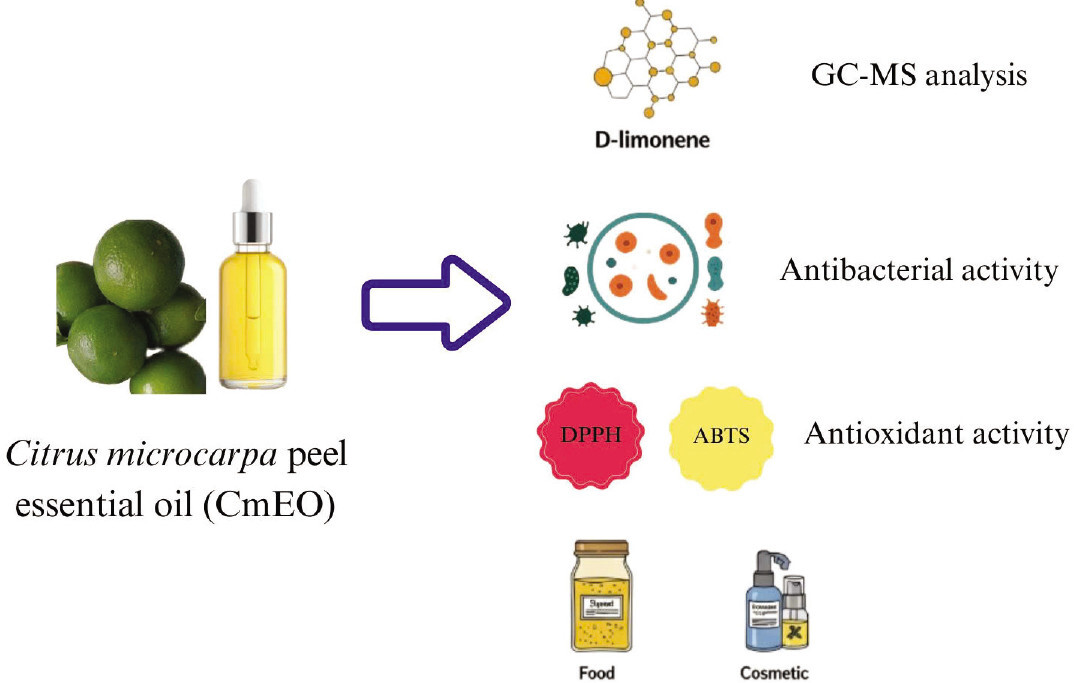
The peel of calamondin is an important source of essential oil (CmEO), containing bioactive compounds with various biological effects. Studies have shown that CmEO mainly consists of monoterpenes such as D-Limonene, γ-Terpinene, and β-Pinene. Furthermore, the presence of oxygenated compounds, including linalool and citronellal, was noted (Chen et al., 2024). These components contribute to the citrus aroma of the essential oil (EO) and its functional properties, including antioxidant, antibacterial, and anti-inflammatory activities (Husni et al., 2020). It has been proven to be effective against common foodborne pathogenic bacteria, specifically Escherichia coli and Staphylococcus aureus, positioning it as a potential natural preservative (Rubiatul et al., 2015).
Beyond culinary applications, CmEO is gaining recognition in the cosmetic and aromatherapy industries because of its refreshing scent and skin-enhancing properties. Research indicates that it can inhibit melanin production, suggesting potential applications in skin-whitening and anti-aging products (Arifin et al., 2024). In addition, its calming and stress-relieving effects have been studied in aromatherapy treatments (Husnayanti et al., 2022).
In spite of its numerous benefits, calamondin peel is often considered a waste in Vietnam. The region has a long tradition of cultivating calamondin, yet the utilization of its peel remains largely untapped. Currently, most calamondin peels are discarded as byproducts after juice processing, leading to resource wastage. Therefore, the study about CmEO contributes to creating added value and jobs for local people. At the same time, this study also provides additional necessary data to supplement important information on this oil from different sources.
2. MATERIALS AND METHODS
2.1. Plant extraction
Calamondin was grown extensively in Vietnam’s Dong Nai. Following harvest, calamondin fruit peels are used to extract EOs, and the fruit’s juice is used to make food and beverages. The extraction efficiency of the steam distillation process, which is run at 100°C for around 3 hours, is 1.2% (v/w). To maintain the EO’s quality and inherent fragrant qualities, it is kept at room temperature in dark glass bottles.
2.2. Bacterial strains
The study employed four bacterial strains from the Institute of Biotechnology and Food Technology, Industrial University of Ho Chi Minh City. The strains consisted of two Gram-positive (Staphylococcus aureus - ATCC 33591 and Bacillus cereus - ATCC 11778) and two Gram-negative bacteria (Escherichia coli - ATCC 25922 and Salmonella enteritidis - ATCC 13076).
2.3. Experimental reagents
For this study, the following chemicals were employed: 2,2’-azinobis(3-ethylbenzothiazoline-6-sulfonic acid) (ABTS, ≥98% purity, Sigma, USA), 2,2-diphenyl-1-picrylhydrazyl (DPPH, ≥97% purity, Sigma, USA), and dimethyl sulfoxide (DMSO, ≥99.5% purity, China). Analytical-grade reagents were employed alongside culture media for antibacterial tests, including nutrient agar (NA) and Mueller–Hinton agar (MHA) (HiMedia, India)
2.4. Characterization of the physical properties of CmEO
Physical properties of CmEO, such as relative density (RD), absolute density (AD), freezing point (FP), acid value (AV), ester value (EV), and saponification value (SV), were measured according to ISO standards: ISO 279 (1998), ISO 1041 (1973), ISO 1242 (2023), and ISO 7660 (1983).
2.5. Fragrance retention (FR)
The concentration and longevity of CmEO were used to evaluate its FR, following the procedure of Bandyopadhyay and Das (2017) with minor modifications. CmEO solutions were prepared at 20, 40, 60, 80, and 100% (v/v) by dilution in 96% ethanol. A few drops of each solution were applied to scent test paper, allowing the mixture to spread evenly after a brief waiting period. The time taken for the fragrance to completely dissipate under normal conditions was recorded to assess its retention.
2.6. Gas chromatography-mass spectrometry (GC-MS) analysis
A 1 µL aliquot of the CmEO was injected into an Agilent 7890A GC system coupled with a 5977E MSD detector for chemical composition analysis. The analysis was performed using GC-MS (Agilent Technologies, USA). The compounds were separated on a Carbowax 20M™ capillary column (30 m × 0.25 mm i.d., 0.25 µm film thickness). The flow of the helium carrier gas was set to 10 mL/minute with a split ratio of 10:1. The injector temperature was 250°C. The oven program started with a 2-minute hold at 50°C, followed by an increase to 250°C at a rate of 10°C/minute (held for 5 minutes), and a final ramp to 280°C for 3 minutes. The resulting mass spectra were recorded using electron ionization (EI) at 70 eV.
2.7. Antioxidant capacity by DPPH assay
To evaluate the antioxidant capacity (AC) of CmEO, the free radical scavenging activity (RSA) was measured with a modified DPPH method, based on the procedure described by Quoc (2020). CmEO solutions at different concentrations were prepared in 96% ethanol. Then, 0.3 mL of the CmEO solution was combined with 2.7 mL of a 0.1 mM DPPH solution and incubated in the dark at room temperature for 30 minutes. The subsequent decrease in DPPH absorbance was measured at 517 nm using a spectrophotometer, with vitamin C serving as the reference standard. The inhibition percentage was calculated as a function of CmEO concentration, and the IC50 value (concentration required to inhibit 50% of DPPH radicals) was determined. AC was subsequently calculated using the following equation:
where A0 represents the absorbance of the DPPH solution, and Asample denotes the absorbance of the CmEO solution in the presence of the DPPH solution.
2.8. Antioxidant capacity by ABTS assay
The ABTS+ was determined by a modified version of the method described by Tsvetkova et al. (2023). A solution of ABTS+ (7 mM) and potassium persulfate (2.45 mM) was mixed in a 1:1 (v/v) ratio and incubated for 16 hours in the dark at room temperature to produce ABTS+ radicals. This stock solution was then diluted with distilled water to an absorbance of 0.70 ± 0.02 at 734 nm. Finally, 0.1 mL of CmEO at various concentrations was combined with 3 mL of the ABTS+ solution, and ethanol was added to bring the total volume to 5 mL. After incubation for 6 minutes in the dark, absorbance was measured at 734 nm. Inhibition percentage and IC50 values were calculated, and AC was expressed using the corresponding formula:
where A0 is the absorbance of the ABTS+ solution without the sample, and Asample is the absorbance of the CmEO solution in the presence of the ABTS+ solution
2.9. Evaluation of antibacterial properties
The antibacterial activity (AA) was assessed using the paper disk diffusion method, adapted from the procedure described by Al-Daihan and Bhat (2012) with some modifications. For the antibacterial assay, 100 µL of a bacterial suspension at a density of approximately 1.5×10⁸ CFU/mL (0.5 McFarland standard) was uniformly spread onto the MHA plates. Five µL of the EO was loaded onto 6 mm sterile paper disks. The study used gentamicin (10 µg/disc) as a positive control and dimethyl sulfoxide (DMSO) (5%, v/v) as a negative control. The plates were incubated at 37°C for 24 hours. Antibacterial efficacy was determined by measuring the diameter of the inhibition zones surrounding the paper disks.
2.10. Data analysis
Data analysis was performed using ANOVA, with post-hoc mean comparisons conducted using Statistics 20 software. A significance level of p ≤ 0.05 was used, and the least significant difference (LSD) test was applied to assess differences. All results are reported as mean ± standard deviation (mean ± SD).
3. RESULTS AND DISCUSSION
3.1. Determination of physicochemical properties of CmEO
CmEO exhibits notable physical properties, with a characteristic pale yellow color, a density of 0.86 g/mL, and a FP below –18°C (Table 1). With a pH of 4.12, this CmEO is mildly acidic, making it suitable for applications in cosmetics and aromatherapy (Mehlich et al., 2021). However, for safe direct application on the skin, dilution is required. Research by Kamal et al. (2011) has also reported similar properties in other citrus EOs, such as the density of Citrus reticulata (0.834 ± 0.02 g/cm3), Citrus paradisi (0.833 ± 0.02 g/cm3), and Citrus sinensis (0.833 ± 0.02 g/cm3) in Pakistan.
Table 1
Physicochemical properties of Citrus microcarpa peel essential oil.
The AV of 0.8436 mg KOH/g and the SV of 2.4664 mg KOH/g of CmEO are relatively low, suggesting a high degree of purity with only minimal amounts of free fatty acids and complex esters (Belarbi et al., 2000). A low AV helps maintain a fresh fragrance but also means that the oil tends to evaporate quickly and has a short-lasting scent (Ba et al., 2013).
The longevity of CmEO’s fragrance depends on its concentration. When used at 100% purity, it retains its scent for approximately 5.83 h. However, as it is diluted, the fragrance duration decreases: 80% (4.98 h), 60% (3.72 h), 40% (2.39 h), and 20% (1.48 h). Overall, even in its pure form, CmEO falls into the category of short-lasting EOs, with a scent duration ranging from 1.5 to 6 hours.
Because of to its high volatility, CmEO is commonly used in fresh-scented products such as light perfumes, diffusers, and natural cosmetics. To enhance its longevity, it can be blended with carrier oils like jojoba or coconut oil or combined with long-lasting EOs such as sandalwood or patchouli to extend its diffusion time and improve scent retention (Chandran et al., 2017).
3.2. Chemical composition of CmEO
GC-MS analysis showed that D-Limonene is the major constituent of CmEO, representing 95.56% of its total volatile compounds (Table 2). This compound overwhelmingly dominates over other identified constituents such as β-Myrcene (2.61%), α-Pinene (1.50%), and Sabinene (0.33%). The high abundance of D-Limonene is characteristic of citrus EOs and is primarily responsible for the distinctive citrus aroma commonly associated with Citrus species. In addition to its sensory contribution, D-Limonene exhibits a wide spectrum of biological and industrially valuable properties, with notable antioxidant, anti-inflammatory, antibacterial, and solvent properties, which makes it especially attractive for incorporation into cosmetic formulations, perfumery, and eco-friendly cleaning products (Han et al., 2019).
Table 2
Chemical composition of Citrus microcarpa peel essential oil.
| No. | Compounds | RT. (min) | Content (%) |
|---|---|---|---|
| 1 | α-Pinene | 3.27 | 1.50 |
| 2 | β-Myrcene | 4.24 | 2.61 |
| 3 | D-Limonene | 4.59 | 95.56 |
| 4 | Sabinene | 4.69 | 0.33 |
| Monoterpene hydrocarbons | 100.00 |
These findings align with previous reports, further supporting the chemical stability and reproducibility of CmEO compositions across different geographical regions. For example, Dao et al. (2022) investigated CmEO from the Ben Tre province in Vietnam and reported an even higher D-Limonene content of 96.93%, with other minor constituents such as β-Myrcene (1.43%) and α-Pinene (0.56%) present in comparable amounts. Similarly, Goncalves et al. (2018) analyzed CmEO samples from China and found that D-Limonene constituted 92.70% of the oil. The convergence of these findings supports the hypothesis that CmEO exhibits a relatively conserved chemotype, likely driven by the species’ genetic makeup and the biosynthetic dominance of monoterpene hydrocarbons, particularly D-Limonene.
In conclusion, the consistent dominance of D-Limonene in CmEO, verified by multiple independent studies, underscores its robustness and versatility as a natural ingredient. The presence of supportive bioactive compounds further enhances its broad-spectrum applicability. Overall, these results emphasize CmEO as a promising candidate for the formulation of safe, multifunctional, and eco-friendly products, with potential applications spanning food preservation, cosmetics, health care, and household use.
3.3. Determination of AC of CmEO
The AC of CmEO was assessed by its free RSA, which was measured using both the DPPH and ABTS assays with IC50 values compared to vitamin C. In the DPPH assay, vitamin C exhibited strong AC with an IC50 of 4.83 µg/mL, significantly lower than CmEO (IC50 = 9.46 mg/mL) (Table 3). This indicates that while CmEO can scavenge free radicals, its AC is significantly weaker than that of vitamin C. The difference may be attributed to the nature of the compounds in CmEO, which primarily consist of monoterpenes and sesquiterpenes—compounds with antioxidant properties but weaker than polyphenols or vitamin C (Ciesla et al., 2016).
Table 3
Antioxidant capacity of Citrus microcarpa peel essential oil.
| Test sample | IC50-DPPH | IC50-ABTS |
|---|---|---|
| Vitamin C (μg/mL) | 4.83a ± 0.28 | 4.98a± 0.11 |
| CmEO (mg/mL) | 9.46b ± 0.14 | 13.95b ± 0.43 |
Similarly, in the ABTS assay, vitamin C demonstrated superior AC (IC50 = 4.98 µg/mL), whereas CmEO had a significantly higher IC50 value (13.95 mg/mL). Compared to the DPPH method, the AC of CmEO was lower in the ABTS+ assay. This variation could be due to the different reaction mechanisms of the two assays: DPPH primarily reacts with hydrogen-donating compounds, whereas ABTS+ interacts with both hydrophilic and lipophilic antioxidants (Christodouleas et al., 2015).
Overall, although CmEO possesses antioxidant activity, it is considerably weaker than vitamin C. However, its moderate antioxidant potential makes it a viable candidate for applications in natural food preservation or cosmetics. To enhance its efficacy, CmEO could be combined with stronger antioxidants or optimized extraction methods to increase the bioactive compound content.
3.4. Determination of AA of CmEO
The antibacterial testing results for E. coli, S. enteritidis, S. aureus, and B. cereus revealed significant differences in the inhibitory effects of gentamicin and CmEO. For S. aureus, CmEO exhibited a relatively strong inhibition, with an inhibition zone diameter of 15.73 mm, which is close to that of gentamicin (16.57 mm) (Table 4). On the other hand, for B. cereus, both gentamicin and CmEO showed relatively weak inhibitory effects, with the diameters of the inhibition zones measuring 14.78 mm and 13.26 mm, respectively, indicating that neither was highly effective against this strain.
Table 4
Antibacterial activity of Citrus microcarpa peel essential oil.
Meanwhile, E. coli and S. enteritidis were more strongly inhibited by gentamicin, with inhibition zone diameters of 20.40 and 20.45 mm, respectively, compared to 10.97 and 7.87 mm for CmEO. This demonstrates that gentamicin is a more effective antibacterial agent against these bacterial strains. However, the results also suggest that CmEO could be a viable alternative to gentamicin for treating S. aureus infections. A study by Iseppi et al. (2021) highlighted that combining EOs with antibiotics offers a potential therapeutic approach for combating antibiotic-resistant bacteria including those capable of surviving in biofilms. This approach could significantly reduce the required antibiotic dosage, thereby minimizing side effects and the risk of resistance.
The antibacterial mechanism of CmEO is likely associated with its major component, D-Limonene, which disrupts bacterial cell membranes by altering lipid membrane permeability and causing intracellular component leakage, ultimately inhibiting bacterial growth (Han et al., 2021). Although CmEO exhibits AA, it does not match the overall effectiveness of gentamicin. However, it may serve as a complementary treatment option, particularly for S. aureus, which has shown sensitivity to the EO.
4. CONCLUSION
This research offers important information on the physicochemical characteristics, AC, and antibacterial effects of CmEO. Its high D-Limonene content (95.56%) suggests promising applications in natural food preservation and cosmetic formulations. CmEO exhibited moderate antioxidant activity, with IC50-DPPH of 9.46 mg/mL and IC50-ABTS of 13.95 mg/mL. In addition, it demonstrated antibacterial efficacy, which resulted in inhibition zones with diameters between 7.87 and 15.73 mm. These findings indicate that CmEO is a viable bioactive compound with potential commercial applications.
AUTHOR CONTRIBUTIONS
Research concept and design were done by N.N.T. and L.P.T.Q.; collection and assembly of data were looked into by N.N.T. and L.P.T.Q.; data analysis and interpretation were the responsibility of P.T.Q. and L.B.B.P.; writing the article was done by L.B.B.P. and L.P.T.Q.; critical revision of the article was accomplished by P.T.Q. and N.N.T.; final approval of the article was the responsibility of N.N.T. and L.P.T.Q. All authors have approved the manuscript for publication.

