About the Journal
Editorial Board
Editorial Office and Publisher
Ownership
Article Processing Charge
Open Access and Licensing
Personal Data Protection
Terms and Conditions: Cookie policy and Privacy policy
Copyright and Copyright Transfer Agreement
Visagaa Publishing House Repository Policy
Visagaa Publishing House CrossMark Policy
The Initiative for Open Citations (I4OC)
Archiving
Plagiarism Policy
Online first
Current issue
Archive
Ethics Statements for Natural Resources for Human Health
Ethical Guidelines
Post-Publication Policies
Responsibilities of Editors and Publishers
Conflict of Interest Statements for Natural Resources for Human Health
Human and Animal Rights Policy
Complaints and Appeals Policy
Allegations of Research Misconduct Policy
Authorship and Contributorship Policy
Publication Ethics and Malpractice Policy
Ethics approval and informed consent
Guidelines for the Use of Generative AI and AI-Assisted Technologies in Manuscripts for Natural Resources for Human Health
For authors
Instructions for Authors
Submitting manuscript – step by step
Authorship and Contributor Guidelines
For reviewers
The peer-review process
Recognition for Reviewers
Visagaa Author Services
About the Journal
Editorial Board
Editorial Office and Publisher
Ownership
Article Processing Charge
Open Access and Licensing
Personal Data Protection
Terms and Conditions: Cookie policy and Privacy policy
Copyright and Copyright Transfer Agreement
Visagaa Publishing House Repository Policy
Visagaa Publishing House CrossMark Policy
The Initiative for Open Citations (I4OC)
Archiving
Plagiarism Policy
Ethics Statements for Natural Resources for Human Health
Ethical Guidelines
Post-Publication Policies
Responsibilities of Editors and Publishers
Conflict of Interest Statements for Natural Resources for Human Health
Human and Animal Rights Policy
Complaints and Appeals Policy
Allegations of Research Misconduct Policy
Authorship and Contributorship Policy
Publication Ethics and Malpractice Policy
Ethics approval and informed consent
Guidelines for the Use of Generative AI and AI-Assisted Technologies in Manuscripts for Natural Resources for Human Health

| eISSN: | 2583-1194 |

REVIEW PAPER
Tulbaghia Violacea Harv.: A Potential Functional Food Source
1
Department of Biotechnology and Biochemistry, Sefako Makgatho Health Sciences University, Ga-Rankuwa, South Africa
Submission date: 2026-01-22
Final revision date: 2026-02-13
Acceptance date: 2026-05-19
Online publication date: 2026-07-17
Corresponding author
Sithembiso Lethukuthula Ndwandwe
Department of Biotechnology and Biochemistry, Sefako Makgatho Health Sciences University, Ga-Rankuwa, South Africa
Department of Biotechnology and Biochemistry, Sefako Makgatho Health Sciences University, Ga-Rankuwa, South Africa

KEYWORDS
TOPICS
ABSTRACT
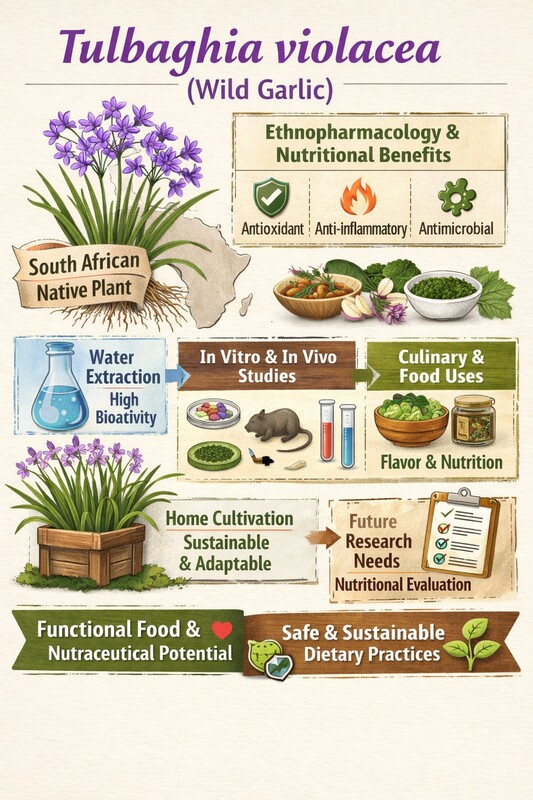
The Tulbaghia violacea Harv. (Alliaceae) is a perennial plant native to South Africa, widely recognized for its role in traditional healing practices and, to some extent, as a functional food. This review explores its potential integration into the everyday diet to ensure consistent intake of beneficial compounds and nutrients. A comprehensive literature search was conducted across databases including Google Scholar, DOAJ, SCOPUS, and Semantic Scholar using targeted keywords. Current evidence highlights the plant’s ethnopharmacological, nutritional, and therapeutic properties, with specific focus on its secondary metabolites, in vitro and in vivo assessments, cultivation, processing, and food applications. For T. violacea, water-based extraction has emerged as a safer, more effective solvent system with high bioactivity. The leaves and roots were identified as safer for consumption compared to stems. There is a need for further nutritional studies in order to evaluate all plant parts to support balanced dietary integration. The plant’s distinctive aroma and volatile compounds suggest culinary potential, while its adaptability and sustainability make it suitable for home cultivation and broader food industry utilization. Collectively, findings position T. violacea as a promising functional food and nutraceutical resource with the capacity to enhance food security, promote health, and contribute to safe, sustainable dietary practices.
REFERENCES (63)
1.
Agregán, R., Munekata, P., Franco, D., Carballo, J., Barba, F., & Lorenzo, J. (2018). Antioxidant potential of extracts obtained from macro- (Ascophyllum nodosum, Fucus vesiculosus, and Bifurcaria bifurcata) and micro-algae (Chlorella vulgaris and Spirulina platensis) assisted by ultrasound. Medicines, 5(2), 33. https://doi.org/10.3390/medici....
2.
Alaouna, M., Hull, R., Molefi, T., Khanyile, R., Mbodi, L., Luvhengo, T.E., Chauke-Malinga, N., Phakathi, B., Penny, C., & Dlamini, Z. (2024). Exploring water-soluble South African Tulbaghia violacea Harv extract as a therapeutic approach for triple-negative breast cancer metastasis. Current Issues in Molecular Biology, 46(10), 10806–10828. https://doi.org/10.3390/cimb46....
3.
Alaouna, M., Molefi, T., Khanyile, R., Chauke-Malinga, N., Chatziioannou, A., Luvhengo, T.E., Raletsena, M., Penny, C., Hull, R., & Dlamini, Z. (2025). The potential of the South African plant Tulbaghia violacea Harv for the treatment of triple negative breast cancer. Scientific Reports, 15(1), 5737. https://doi.org/10.1038/s41598....
4.
Aremu, A.O., & Van Staden, J. (2013). The genus Tulbaghia (Alliaceae)—A review of its ethnobotany, pharmacology, phyto-chemistry and conservation needs. Journal of Ethnopharmacology, 149(2), 387–400. https://doi.org/10.1016/j.jep.....
5.
Arooj, M., & Khalid, N. (2024). Dietary herbs: Ancient use, modern advancements and health prospects in the 21st century. Food Science and Nutrition Cases, fsncases20240011. https://doi.org/10.1079/fsncas....
6.
Belewa, V., Baijnath, H., Frost, C., & Somai, B.M. (2017). Tulbaghia violacea Harv. plant extract affects cell wall synthesis in Aspergillus flavus. Journal of Applied Microbiology, 122(4), 921–931. https://doi.org/10.1111/jam.13....
7.
Bvenura, C., & Kambizi, L. (2024). Food Security and Nutrition. CRC Press. https://doi.org/10.1201/978100....
8.
Eid, H.H., & Metwally, G.F. (2017). Phytochemical and biological study of callus cultures of Tulbaghia violacea Harv. Cultivated in Egypt. Natural Product Research, 31(15), 1717–1724. https://doi.org/10.1080/147864....
9.
Gbemisola, M.S., Rahmon, I.K., Kayode, P.O., Grant, G.J., Iyapo, O., Gideon, A.A., Ahmed, O.B., Jelili, A.B., Kazeem, I.M., & Oluwatosin, B.A. (2022). Comparative Evaluation of Sutherlandia frutescens and Tulbaghia violacea Antioxidant Potential. Asian Journal of Biochemistry, Genetics and Molecular Biology, 1–11. https://doi.org/10.9734/ajbgmb....
10.
Ghout, A., Zellagui, A., Gherraf, N., Demirtas, I., Ayse Sahin, Y., Boukhenaf, M., Lahouel, M., Nieto, G., & Akkal, S. (2018). Antiproliferative and antioxidant activities of two extracts of the plant species Euphorbia dendroides L. Medicines, 5(2), 36. https://doi.org/10.3390/medici....
11.
Grigoriadou, K., Cheilari, A., Dina, E., Alexandri, S., & Aligiannis, N. (2023). Medicinal and aromatic plants as a source of potential feed and food additives. In Sustainable Use of Feed Additives in Livestock (pp. 117–135). Springer International Publishing. https://doi.org/10.1007/978-3-....
12.
Ivanišová, E., Kačániová, M., A. Savitskaya, T., & D. Grinshpan, D. (2021). Medicinal herbs: important source of bioactive compounds for food industry. In Herbs and Spices - New Processing Technologies. IntechOpen. https://doi.org/10.5772/intech....
13.
Jäger, A. K., & Stafford, G. I. (2012). Quality assessment of Tulbaghia rhizomes. South African Journal of Botany, 82, 92–98. https://doi.org/10.1016/j.sajb....
14.
Jamshidi-Kia, F., Lorigooini, Z., & Amini-Khoei, H. (2018). Medicinal plants: Past history and future perspective. Journal of Herbmed Pharmacology, 7(1), 1–7. https://doi.org/10.15171/jhp.2....
15.
Jaradat, N., Zaid, A., Hussein, F., Zaqzouq, M., Aljammal, H., & Ayesh, O. (2017). Anti-lipase potential of the organic and aqueous extracts of ten traditional edible and medicinal plants in palestine; a comparison study with Orlistat. Medicines, 4(4), 89. https://doi.org/10.3390/medici....
16.
Jongberg, S., Tørngren, M., & Skibsted, L. (2018a). Dose-dependent effects of green tea or maté extracts on lipid and protein oxidation in brine-injected retail-packed pork chops. Medicines, 5(1), 11. https://doi.org/10.3390/medici....
17.
Jongberg, S., Tørngren, M., & Skibsted, L. (2018b). Protein oxidation and sensory quality of brine-injected pork loins added ascorbate or extracts of green tea or maté during chill-storage in high oxygen modified atmosphere. Medicines, 5(1), 7. https://doi.org/10.3390/medici....
18.
Kader, T., Sibiya, N., Mapfumari, S., & Mothibe, M. (2025). Phytochemical composition, antioxidant and in vitro enzyme-based antidiabetic activities of tulbaghia violacea collected from the Eastern Cape and Gauteng Provinces, South Africa. https://doi.org/10.20944/prepr....
19.
Krstin, S., Sobeh, M., Braun, M., & Wink, M. (2018). Tulbaghia violacea and Allium ursinum Extracts Exhibit Anti-Parasitic and Antimicrobial Activities. Molecules, 23(2), 313. https://doi.org/10.3390/molecu....
20.
Kumari, M., Singh, S., Puri, S., Thakur, N., Thakur, A., Dulta, K., Shukla, R.K., Dehghani, M.H., & Ghosh, S. (2025). Investigation of nutritional and phytochemical properties of wild medicinal plant species. Scientific Reports, 15(1), 43405. https://doi.org/10.1038/s41598....
21.
Li, X., Liu, Y., Liu, N., Wu, H., Cong, K., Duan, L., Chen, T., & Zhang, J. (2025). Health benefits of medicinal plant natural prod-ucts via microbiota-mediated different gut axes. Pharmacological Research, 215, 107730. https://doi.org/10.1016/j.phrs....
22.
Madike, L.N., Pillay, M., & Popat, K.C. (2020). Antithrombogenic properties of Tulbaghia violacea–loaded polycaprolactone nanofibers. Journal of Bioactive and Compatible Polymers, 35(2), 102–116. https://doi.org/10.1177/088391....
23.
Madike, L.N., Pillay, M., & Popat, K.C. (2021). Antithrombogenic properties of Tulbaghia violacea aqueous leaf extracts: assessment of platelet activation and whole blood clotting kinetics. RSC Advances, 11(48), 30455–30464. https://doi.org/10.1039/D1RA00....
24.
Madike, L.N., Takaidza, S., Ssemakalu, C.C., & Pillay, M. (2020). The effect of extracts of Tulbaghia violacea on the proliferation of a murine macrophage cell line. South African Journal of Botany, 130, 185–197. https://doi.org/10.1016/j.sajb....
25.
Madike, L.N., Takaidza, S., Ssemakalu, C., & Pillay, M. (2019). Genotoxicity of aqueous extracts of Tulbaghia violacea as determined through an Allium cepa assay. South African Journal of Science, 115(1/2). https://doi.org/10.17159/sajs.....
26.
Makhoahle, P.M., & Rampana, D.E. (2023). Antioxidant activities, total polyphenol profile and anticancer activity, of leaf, bulb and root extracts of Tulbaghia violacea from Bloemfontein. Pharmacognosy Journal, 15(5), 761–767. https://doi.org/10.5530/pj.202....
27.
Makhuvele, R., Gbashi, S., & Njobeh, P.B. (2022). GC-HRTOF-MS metabolite profiling and antioxidant activity of methanolic extracts of Tulbaghia violacea Harv. Journal of King Saud University - Science, 34(7), 102278. https://doi.org/10.1016/j.jksu....
28.
Maleka, G., Oyerinde, R. O., & Risenga, I. M. (2024). Comparative phytochemical profiling and biological activities in the flowers and stalks of Tulbaghia violacea. Borneo Journal of Pharmacy, 7(1), 14–28. https://doi.org/10.33084/bjop.....
29.
Malini, G., Saranya, B., & Parameswari, A. (2023). Review on extraction techniques for medicinal and aromatic plants. International Journal of Pharmaceutical Chemistry and Analysis, 10(4), 253–256. https://doi.org/10.18231/j.ijp....
30.
Marchioni, I., Najar, B., Copetta, A., Ferri, B., Ruffoni, B., Pistelli, L., & Pistelli, L. (2023). Phytonutritional and aromatic profiles of Tulbaghia simmleri Beauv. edible flowers during cold storage. Advances in Horticultural Science, 37(1), 25–32. https://doi.org/10.36253/ahsc-....
31.
Moodley, K., Joseph, K., Naidoo, Y., Islam, S., & Mackraj, I. (2015). Antioxidant, antidiabetic and hypolipidemic effects of Tulbaghia vio-lacea Harv. (wild garlic) rhizome methanolic extract in a diabetic rat model. BMC Complementary and Alternative Medicine, 15(1), 408. https://doi.org/10.1186/s12906....
32.
Moodley, K., & Mackraj, I. (2016). Metabolic effects of Tulbaghia violacea HARV. in a diabetic model. African Journal of Traditional, Complementary and Alternative Medicines, 13(4), 113–122. https://doi.org/10.21010/ajtca....
33.
Moodley, K., Naidoo, Y., & Mackraj, I. (2014). Effects of Tulbaghia violacea Harv. (Alliaceae) rhizome methanolic extract on kidney function and morphology in Dahl salt-sensitive rats. Journal of Ethnopharmacology, 155(2), 1194–1203. https://doi.org/10.1016/j.jep.....
34.
Motadi, L.R., Choene, M.S., & Mthembu, N.N. (2020). Anticancer properties of Tulbaghia violacea regulate the expression of.
35.
p53-dependent mechanisms in cancer cell lines. Scientific Reports, 10(1), 12924. https://doi.org/10.1038/s41598....
36.
Ncise, W., Daniels, C.W., & Nchu, F. (2017). The effect of enviromental stress on the phytochemistry and bioactivity responses of a South African medicinal bulbous plant Tulbaghia violacea. South African Journal of Botany, 109, 358. https://doi.org/10.1016/j.sajb....
37.
Ncube, B., Finnie, J.F., & Van Staden, J. (2012). Quality from the field: The impact of environmental factors as quality determinants in medicinal plants. South African Journal of Botany, 82, 11–20. https://doi.org/10.1016/j.sajb....
38.
Ndlovu, B., Fisher, R., & Fisher (née Rahiman), F. (2025). Phenolic-rich extracts of Galenia africana and Tulbaghia violacea accelerate keratinocyte migration and mitigate oxidative stress to enhance wound healing. Plants, 14(22), 3523. https://doi.org/10.3390/plants....
39.
Netshiluvhi, T.R., & Eloff, J.N. (2024). Temperature and water stresses on antioxidant activity of selected medicinal plants have implications for sustainable use and global warming. South African Journal of Botany, 170, 177–180. https://doi.org/10.1016/j.sajb....
40.
Nieto, G. (2020). How are medicinal plants useful when added to foods? Medicines, 7(9), 58. https://doi.org/10.3390/medici....
41.
Nieto, G., Ros, G., & Castillo, J. (2018). Antioxidant and antimicrobial properties of rosemary (Rosmarinus officinalis, L.): A Review. Medicines, 5(3), 98. https://doi.org/10.3390/medici....
42.
Olorunnisola, O.S., Bradley, G., & Afolayan, A.J. (2012). Protective effect of Tulbaghia violacea Harv. on aortic pathology, tissue antioxidant enzymes and liver damage in diet-induced atherosclerotic rats. International Journal of Molecular Sciences, 13(10), 12747–12760. https://doi.org/10.3390/ijms13....
43.
Oyerinde, R.O., & Risenga, I.M. (2025). Bioactive compound characterization and phytopharmacological potentials of Tulbaghia viola-cea fruits and seeds. Chemistry & Biodiversity, 22(6), e202403198. https://doi.org/10.1002/cbdv.2....
44.
Oyewole, S.O., Akinyemi, O., & Jimoh, K.A. (2018). Medicinal plants and sustainable human health: a review. Horticulture International Journal , 2(4), 194-195. https://doi.org/10.15406/hij.2....
45.
Pachisia, J. (2025). 8 Medicinal plants as functional food: a review. Medicinal Plants as Functional Food: A Review, 8(2), 1-21. https://doi.org/10.1136/bmjnph....
46.
Pandey, A., Mishra, A., Mohanta, S., Manohar Kandileri, A., Shukla, G., & Chakravarty, S. (2025). Wild edible plants and their role in alle-viating nutritional deficiency: an indian context. In Forest Science – Advances towards Sustainable Development and Climate Resilience. IntechOpen. https://doi.org/10.5772/intech....
47.
Phelan, S., Douglas, G., & Hunter, A. (2007). Micropropagation and growth regulation of Tulbaghia violacea “SILVER LACE.” Acta Horticulturae, (764), 113–118. https://doi.org/10.17660/ActaH....
48.
Pranskuniene, Z., Bajoraite, R., Simaitiene, Z., & Bernatoniene, J. (2021). Home gardens as a source of medicinal, herbal and food preparations: modern and historical approaches in Lithuania. Applied Sciences, 11(21), 9988. https://doi.org/10.3390/app112....
49.
Raji, I., Mugabo, P., & Obikeze, K. (2013). The contributions of muscarinic receptors and changes in plasma aldosterone levels to the anti-hypertensive effect of Tulbaghia violacea. BMC Complementary and Alternative Medicine, 13(1), 13. https://doi.org/10.1186/1472-6....
50.
Raji, I., Obikeze, K., & Mugabo, P. (2015). Potential Beneficial Effects of Tulbaghia violacea William Henry Harvey (Alliaceae) on cardiovascular system – a review. Tropical Journal of Pharmaceutical Research, 14(6), 1111. https://doi.org/10.4314/tjpr.v....
51.
Rampana, D. E., Makhoahle, P. M., & Mashele, S. S. (2022). Anticancer, cytotoxicity, and genotoxicity assays of Tulbaghia viola-cea extracts. Journal of Advanced Pharmacy Education and Research, 12(4), 27–31. https://doi.org/10.51847/Ceo7s....
52.
Ranglová, K., Krejčová, P., & Kubec, R. (2015). The effect of storage and processing on antimicrobial activity of Tulbaghia violacea. South African Journal of Botany, 97, 159–164. https://doi.org/10.1016/j.sajb....
53.
Rivas-García, L., Romero-Márquez, J. M., Navarro-Hortal, M. D., Esteban-Muñoz, A., Giampieri, F., Sumalla-Cano, S., Battino, M., Quiles, J. L., Llopis, J., & Sánchez-González, C. (2022). Unravelling potential biomedical applications of the edible flower Tulbaghia violacea. Food Chemistry, 381, 132096. https://doi.org/10.1016/j.food....
54.
Rumicha, T.D., Belew, S., Hasen, G., Teka, T.A., & Forsido, S.F. (2025). Food, feed, and phytochemical uses of wild edible plants: a systematic review. Food Science & Nutrition, 13(6). https://doi.org/10.1002/fsn3.7....
55.
Saibu, G.M., Katerere, D.R., Rees, D.J.G., & Meyer, M. (2015). In vitro cytotoxic and pro-apoptotic effects of water extracts of Tulbaghia violacea leaves and bulbs. Journal of Ethnopharmacology, 164, 203–209. https://doi.org/10.1016/j.jep.....
56.
Soyingbe, O.S., Oyedeji, O.A., Basson, A.K., Singh, M., & Opoku, A.R. (2013). Chemical composition, antimicrobial and antioxidant properties of the essential oils of Tulbaghia violacea Harv L.F. African Journal of Microbiology Research, 7(18), 1787–1793. https://doi.org/10.5897/AJMR12....
57.
Street, R.A., Kulkarni, M.G., Stirk, W.A., Southway, C., & Van Staden, J. (2010). Effect of cadmium on growth and micronutri-ent distribution in wild garlic (Tulbaghia violacea). South African Journal of Botany, 76(2), 332–336. https://doi.org/10.1016/j.sajb....
58.
Styger, G., Aboyade, O.M., Gibson, D., & Hughes, G. (2016). Tulbaghia— A Southern African Phytomedicine. The Journal of Alternative and Complementary Medicine, 22(4), 255–261. https://doi.org/10.1089/acm.20....
59.
Takaidza, S., Ssemakalu, C.C., Chukwuneme, C.F., & Pillay, M. (2025). Immunomodulatory effects of crude acetone and water leaf extracts from Tulbaghia violacea on RAW264.7 cells stimulated with lipopolysaccharide (LPS). Journal of HerbMed Pharmacology, 14(2), 217–229. https://doi.org/10.34172/jhp.2....
60.
Thalia, O.P. (2025). The Cultural Significance of Medicinal Plants in Treating Chronic Conditions. Newport International Journal of Research in Medical Sciences, 6(2), 59–65. https://doi.org/10.59298/NIJRM....
61.
Wani, M.A., & Upadhyay, V. (2026). Medicinal plants and their ther-apeutic advantages: a comprehensive review. International Journal of Applied Research, 12(1), 31–33. https://doi.org/10.22271/allre....
62.
Xu, Y., Liang, D., Wang, G.-T., Wen, J., & Wang, R.-J. (2020). Nutritional and functional properties of wild food-medicine plants from the coastal region of South China. Journal of Evidence-Based Integrative Medicine, 25, 2515690X2091326. https://doi.org/10.1177/251569....
63.
Zambrano Núñez, T.M., Morales Noriega, A.M., García-Martínez, M.D., & Raigón Jiménez, M. D. (2025). Aromatic and nutritional compo-sition of edible flowers of garden garlic and wild leek. Horticulturae, 11(3), 323. https://doi.org/10.3390/hortic....
Share
RELATED ARTICLE
| eISSN: | 2583-1194 |

We process personal data collected when visiting the website. The function of obtaining information about users and their behavior is carried out by voluntarily entered information in forms and saving cookies in end devices. Data, including cookies, are used to provide services, improve the user experience and to analyze the traffic in accordance with the Privacy policy. Data are also collected and processed by Google Analytics tool (more).
You can change cookies settings in your browser. Restricted use of cookies in the browser configuration may affect some functionalities of the website.
You can change cookies settings in your browser. Restricted use of cookies in the browser configuration may affect some functionalities of the website.
