


1. INTRODUCTION
Throughout human history, natural products derived from plants have formed the foundation of traditional medicine systems and served as a critical reservoir for the development of modern pharmaceuticals (Veeresham, 2012). It is estimated that a substantial portion of all approved drugs, particularly in therapeutic areas such as oncology, originate from or are inspired by natural products, confirming their irreplaceable role in global health (Cragg & Pezzuto, 2016; Ganesan, 2008). The intricate chemical diversity found within the plant kingdom represents a vast, evolutionarily tested library of bioactive compounds, providing unparalleled starting points for drug discovery programs (Kinghorn et al., 2011; Rodrigues et al., 2016). The discipline of ethnopharmacology seeks to unlock this potential in a targeted manner, applying modern scientific methods to validate and understand the therapeutic claims of traditional plant-based remedies (Heinrich & Gibbons, 2001). This ethnobotanically-guided approach has been consistently recognized as a more rational and effective strategy for discovering novel lead compounds compared to the random screening of unselected plant materials (Soelberg & Jäger, 2016). As such, the systematic investigation of the world’s medicinal flora remains a central and highly promising pillar in the ongoing search for future medicines.
The North African region, stretching across the Mediterranean and Maghreb territories, represents a particularly fertile ground for ethnopharmacological research. This area is recognized as a major global biodiversity hotspot, characterized by a high degree of plant endemism and a rich flora shaped by diverse climatic and geographical conditions (Médail and Quézel, 1997). For millennia, this botanical wealth has been intricately woven into the fabric of local cultures, leading to the development of sophisticated traditional medicine systems that are still widely practiced today (Bellakhdar, 1997; Sijelmassi, 1996). This unique convergence of biological and cultural diversity has fueled a vibrant and rapidly expanding body of research aimed at documenting and validating the region’s medicinal plants (Eddouks et al., 2002). Numerous local and regional ethnobotanical surveys have been conducted, yielding vast catalogs of plants used for a wide range of ailments (Boulos, 1983; Merzouki et al., 2000). However, while this primary research has been incredibly productive, it has also created a highly fragmented intellectual landscape. To date, no comprehensive, large-scale quantitative analysis has been undertaken to map the structure, evolution, and key thematic trends of this entire research domain. This represents a critical knowledge gap, as the absence of such a macroscopic overview hinders the ability to identify major research clusters, understudied areas, and strategic priorities for future investigation (Fahimnia et al., 2015).
To address this knowledge gap, bibliometric analysis offers a powerful and objective methodology for quantitatively mapping the structure and dynamics of a scientific field (Ellegaard & Wallin, 2015). By leveraging statistical analysis of publication and citation data, this approach makes it possible to delineate the conceptual boundaries of a domain, identify key research themes, and uncover the social networks that drive knowledge production (Börner et al., 2003; Small, 1973). This “science of science” approach has become an essential tool for understanding the evolution of research areas and providing evidence-based guidance for future research strategies (Fortunato et al., 2018). In recent years, bibliometric methods have been increasingly applied to chart the research landscape of ethnopharmacology as a whole (Yeung et al., 2018) and to uncover specific trends within medicinal plant extract research (El Allaoui et al., 2024), demonstrating their direct utility in this context. Therefore, the objective of this study is to conduct the first comprehensive bibliometric analysis of the scientific literature on the medicinal plants of North Africa. We aim to map its conceptual, intellectual, and social structures; to trace its historical evolution and identify its most influential contributors; and to outline its emerging frontiers, thereby providing a definitive, data-driven overview of this vital research field (Cobo et al., 2011).
2. MATERIALS AND METHODS
2.1. Data collection and search strategy
To construct a comprehensive and focused bibliographic dataset, the Scopus database was selected as the sole data source due to its extensive coverage of peer-reviewed scientific literature. All data were retrieved on a single day in mid-June 2025 to ensure the consistency of the dataset and establish a fixed point for the analysis.
The search query was meticulously designed to be exhaustive, combining three main conceptual blocks within the title, abstract, and keyword fields (TITLE-ABS-KEY). The first block targeted the core theme, using a wide array of synonyms for “medicinal plants,” “herbal medicine,” and “ethnopharmacology” to ensure broad thematic coverage. The second block geographically focused the search on the five North African countries: Algeria, Morocco, Tunisia, Libya, and Egypt. These two blocks were combined to retrieve documents that addressed the core theme within the specified geographical context.
The search was further refined using Scopus limiters to adhere to the following strict inclusion criteria: (a) The publication year was limited to the period between January 1, 2000, and December 31, 2024. (b) Document types were restricted to articles (“ar”), reviews (“re”), book chapters (“ch”), and conference papers (“cp”). (c) The search was limited to documents published in the English language. (d) A filter was applied to include only documents where at least one affiliated author was from one of the five target North African countries, ensuring that the retrieved research was primarily produced by institutions located within the region of study. (e) The search was confined to relevant subject areas, including Pharmacology, Agriculture, Medicine, Biochemistry, Chemistry, and Environmental Science, among others. After an initial screening to remove irrelevant entries, the final corpus consisted of 1906 documents, which were exported in Comma-Separated Values (CSV) format for analysis.
2.2. Data analysis and science mapping
All data processing and bibliometric analyses were performed using the R language and environment for statistical computing (R Core Team, 2023) within the RStudio interface. Specifically, the bibliometrix R-package was the primary tool for conducting the comprehensive science mapping analysis (Aria & Cuccurullo, 2017). The analysis was structured into two main stages: performance analysis and science mapping.
Performance analysis quantified the scientific output and impact of the main contributors to the field, including the most productive sources, countries, institutions, and authors. Science mapping visualized the intellectual and social structures of the research field. This involved co-occurrence analysis of the Author’s Keywords to identify key research themes, thematic evolution analysis to track their development over time, and collaboration analysis to map the social networks. The underlying network data for these analyses were processed and exported using the bibliometrix package, and VOSviewer software was used for network layout verification and preliminary visualization (van Eck & Waltman, 2010). However, all final figures presented in this paper were rendered using the R environment and its associated graphical packages to achieve the highest visual quality required for publication.
3. RESULTS AND DISCUSSION
3.1. Results
3.1.1. General statistics and publication trends
The final dataset comprised 1906 documents published between 2000 and 2024. This body of work was authored by a broad and active scientific community of 6669 researchers. The analysis revealed a highly collaborative research culture, with an average of nearly 5.48 co-authors per document, while single-authored papers constituted only 3.5% of the collection (67 documents). The dataset demonstrated a significant scientific impact, averaging 23.92 citations per document, with a strong and sustained annual growth rate of 12.46%, signifying an increasing scholarly interest in the topic.
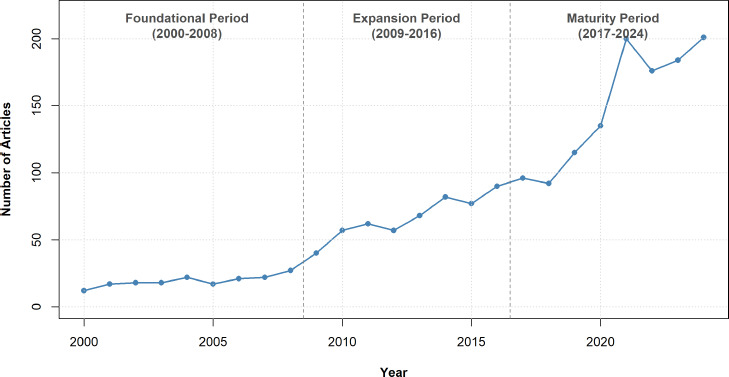
The temporal distribution of publications reveals three distinct evolutionary phases in the history of this research field (Figure 1). The first phase, the Foundational Period (2000–2008), was characterized by sporadic and limited publication activity, with less than 30 articles published per year. The second phase, the Expansion Period (2009–2016), marked a period of significant and accelerated growth, with annual publications rising substantially to range between 40 and 90 articles. The final and most recent phase, the Maturity Period (2017–present), shows a sharp, exponential increase in research output. Publications in this period consistently exceeded 90 articles per year, peaking at over 200 articles in 2021 and 2024, indicating a major surge of scientific interest and maturity on the topic.
3.1.2. Performance analysis and leading contributors
To further delineate the structure of the research landscape, a performance analysis was conducted to identify the most productive sources. The 1906 documents in the collection were published across 654 distinct sources, indicating a broad and interdisciplinary interest in the topic.
3.1.2.1. Analysis of sources
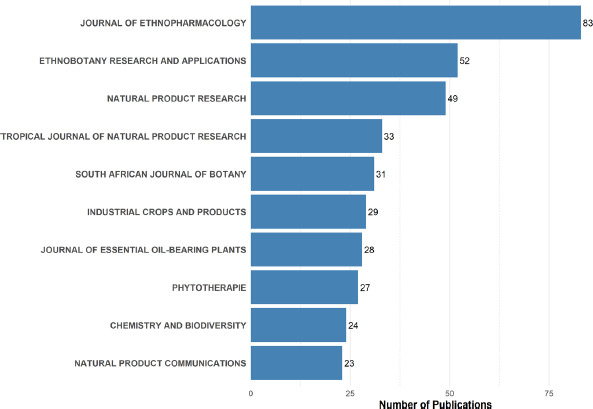
The analysis of publication sources reveals that the most frequent and impactful articles are highly concentrated in journals specializing in ethnopharmacology, ethnobotany, and natural product chemistry. The Journal of Ethnopharmacology emerges as the undisputed leader and the most central publication venue for this research field, with 83 articles. A distinct group of specialized journals follows, including Ethnobotany Research and Applications and Natural Product Research. Figure 2 presents the top 10 most productive journals, highlighting the core publication venues that have shaped this research domain.
3.1.2.2. Geographical distribution of research
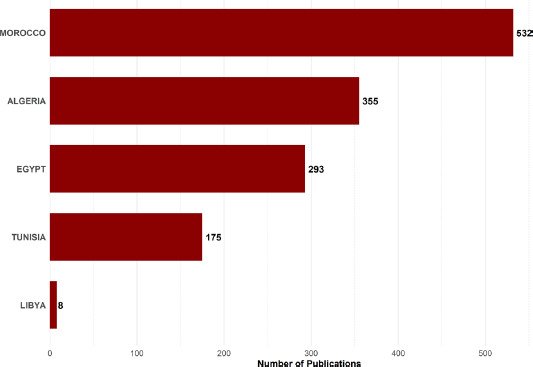
The geographical distribution of publications within the North African region reveals a clear hierarchy of research productivity. As illustrated in Figure 3, scientific output is led by Morocco (532 articles) and Algeria (355 articles), which have established themselves as the dominant regional hubs for this research domain. A second tier of highly active countries follows, which includes Egypt (293 articles) and Tunisia (175 articles), while Libya also contributes to the body of knowledge. These nations collectively form the scientific backbone of the research community in the region.
3.1.2.3. Leading institutions
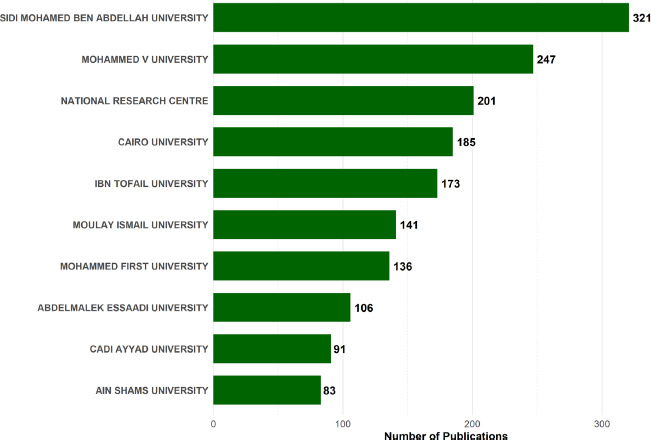
At the institutional level, the analysis pinpoints the specific academic centers driving research innovation. The scientific output is dominated by a consortium of universities from Morocco and research centers in Egypt. Sidi Mohamed Ben Abdellah University emerges as the clear global leader in this field with an exceptionally high output of 321 articles. Mohammed V University ranks the second most productive institution with a total of 247 publications, closely followed by major Egyptian institutions, the National Research Center (201 articles), Cairo University (185 articles), and Ain Shams University (83 articles). This underscores the vital role these two countries in shaping the research landscape. Figure 4 illustrates the top 10 institutions, revealing a concentration of expertise primarily within these key Moroccan and Egyptian academic centers.
3.1.2.4. Leading authors
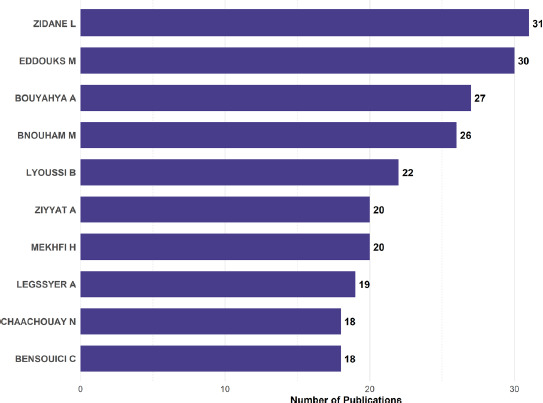
The analysis of the most productive authors is crucial for identifying the key researchers driving the field’s progress. The intellectual landscape has been shaped by several highly influential scholars. Zidane L emerges as the most prolific author with 31 publications, closely followed by Eddouks M with 30 publications, whose work was foundational in the earlier stages of the field’s development. The data also reveal a distinct and highly collaborative cohort of researchers, including Bnouham M (26 articles), Lyoussi B (22 articles), Mekhfi H (20 articles), Ziyyat A (20 articles), and Legssyer A (19 articles), who form a significant research cluster. Other major contributors, such as Bouyahya A, Bensouici C, and Chaachouay N, complete the list of the most influential researchers in this domain. Figure 5 presents the top 10 most prolific authors, providing a quantitative overview of the most central contributors to this body of literature.
3.1.3. The conceptual structure
To map the intellectual core of the field, a keyword co-occurrence network was generated, revealing the primary research themes and their interconnections (Figure 6). The analysis identifies a highly structured landscape organized into seven major thematic clusters. These clusters represent the dominant schools of thought and application domains, tracing the research pipeline from traditional knowledge to mechanistic studies.
Figure 6
Conceptual structure of the research field based on keyword co-occurrence analysis. The network visualizes the main thematic clusters, illustrating the research pipeline from traditional knowledge to advanced mechanistic studies.
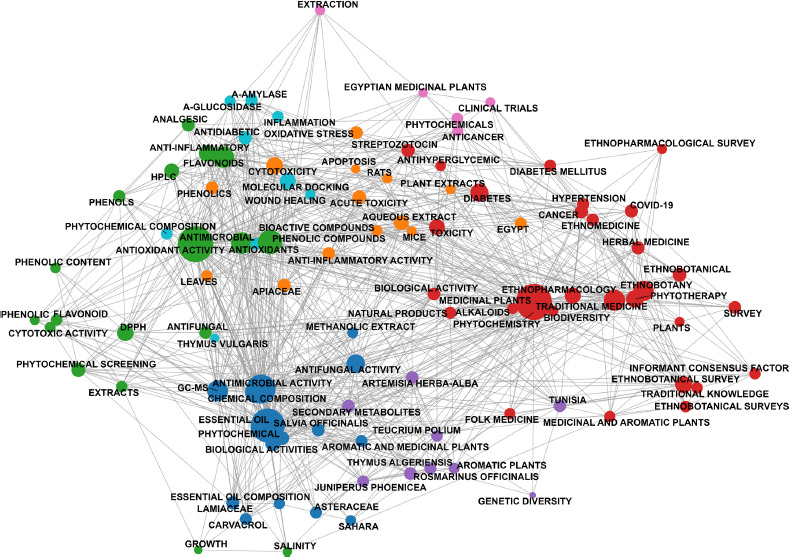
The largest cluster (Cluster 1, Red) represents the “Ethnobotany and Ethnopharmacology Hub.” This theme is the foundational pillar of the field, anchored by core concepts such as “medicinal plants,” “ethnobotany,” “traditional medicine,” and “ethnophamacological survey.” It highlights the importance of documenting traditional knowledge to address prevalent health issues such as “diabetes,” “hypertension,” and “cancer.”
The second major cluster (Cluster 2, Green) focuses on “Phytochemical Analysis and In-Vitro Bioactivity.” This theme constitutes the primary laboratory-based validation of traditional claims. It is defined by terms such as “antioxidant activity,” “phenolic compounds,” “flavonoids,” “anti-inflammatory,” and “cytotoxic activity,” showcasing the extensive screening of plant-derived compounds for their biological effects.
Tightly linked to this is (Cluster 3, Blue), a highly specialized cluster centered on “Essential Oils and Antimicrobial Research.” This theme is driven by the analysis of volatile compounds using techniques such as GC-MS to determine their chemical composition. The primary applications explored are “antimicrobial activity” and “antifungal activity.”
The fourth cluster (Cluster 4, Orange) represents “Preclinical In-Vivo Studies and Toxicology.” This is the critical animal testing phase, characterized by keywords such as “rats,” “mice,” “plant extracts,” “aqueous extract,” and “acute toxicity,” which validates the effects observed in-vitro and assesses safety.
Cluster 5, Purple, focuses on “Aromatic Plants, Chemotaxonomy, and Biodiversity.” This theme connects specific plant types, such as “aromatic plants” and species such as Artemisia herba-alba, to their “secondary metabolites” and “genetic diversity”, with “Tunisia” appearing as a key geographical focus.
Cluster 6, Teal, delves into “Mechanistic and Enzymatic Studies.” This advanced theme explores specific molecular mechanisms, featuring keywords such as “molecular docking” and enzyme inhibition targets such as “α-amylase” and “α-glucosidase,” crucial for antidiabetic research.
Finally, (Cluster 7, Pink) represents the small but crucial “Translational and Anticancer Research” frontier. This theme links the extraction of “phytochemicals” to advanced applications, including “anticancer” studies and “clinical trials,” pointing toward the ultimate goal of the research pipeline.
3.1.4. Thematic evolution
To understand the dynamic shifts in research focus across the study period, a thematic evolution analysis was conducted, dividing the timeline into three phases: Foundational (2000–2008), Expansion (2009–2016), and Specialization (2017–2024). The resulting Sankey diagram (Figure 7) illustrates the flow and transformation of key research themes.
Figure 7
Thematic evolution of keywords across three periods (2000–2008, 2009–2016, 2017–2024). The diagram illustrates the flow and transformation of research themes, highlighting the progression from foundational ethnobotanical observation to standardized bioactivity screening, and finally to a sophisticated, chemically-focused search for novel therapeutic agents.
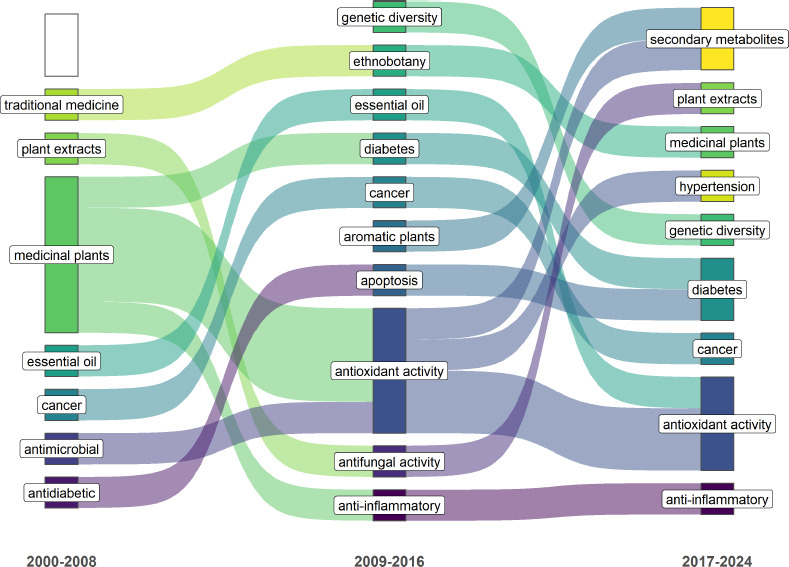
The Foundational Period (2000–2008) was characterized by descriptive and exploratory research. The field was anchored by broad concepts such as “medicinal plants” and “essential oil,” alongside initially focused bioactivity screenings.
The Expansion Period (2009–2016) marked a significant consolidation and diversification. A major shift occurred as “antioxidant activity” emerged as a dominant hub, absorbing and unifying many of the earlier, more diffuse bioactivity themes. This indicates a standardization of in-vitro screening methodologies. Concurrently, research on traditional knowledge matured, evolving from the general term “traditional medicine” into the more scientific discipline of “ethnobotany.” Furthermore, specific therapeutic areas gained significant momentum, with “diabetes” and “anti-inflammatory” research crystallizing as major, well-defined themes.
The current Specialization Period (2017–2024) reflects the maturation of the field, defined by a distinct move toward chemical and mechanistic depth. While foundational themes such as “antioxidant activity,” “diabetes,” and “anti-inflammatory” research continue, the most significant development is the rise of “secondary metabolites” as a key topic, signaling a shift from studying whole extracts to identifying the specific molecules responsible for their effects. This period also saw the emergence of new, targeted therapeutic applications, such as “hypertension,” and a growing interest in biodiversity and conservation, indicated by the persistence of “genetic diversity.” Overall, the thematic map reveals a clear and logical progression from ethnobotanical observation to standardized bioactivity screening, and finally to a sophisticated, chemically-focused search for novel therapeutic agents.
3.1.5. Social structure: Collaboration patterns
To investigate the social structure of the field, collaboration networks were analyzed at both the author and country levels.
3.1.5.1. Author collaboration network
The author collaboration network reveals a highly compartmentalized “archipelago” structure, formed by distinct research clusters with dense internal collaborations but limited inter-cluster connections (Figure 8). This structure suggests that knowledge production is concentrated within well-defined, independent research consortia or “invisible colleges.”
Figure 8
The author collaboration network, illustrating a fragmented “archipelago” structure. The network is defined by a dominant central super-cluster, several isolated peripheral groups, and a crucial intermediary “broker” cluster occupying a key structural position. Node size is proportional to the author’s total link strength, and colors represent distinct collaboration clusters.
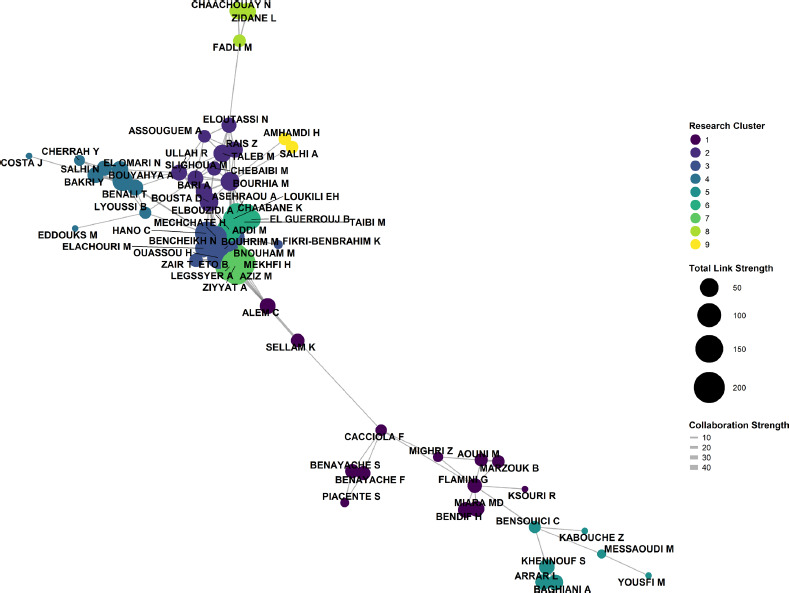
The network is anchored by a large and dominant supercluster that constitutes the field’s collaborative core. This central mass is primarily composed of a highly interconnected consortium (in green and dark blue) led by key authors such as Ziyyat A, Legssyer A, Mekhfi H, and Bnouham M. Positioned strategically between this central core and the peripheral groups is a crucial intermediary “broker” cluster. This single, cohesive yellow cluster is led by a tight-knit collaboration between authors such as Salhi A and Amhamdi H. Due to its unique structural position bridging the most distant parts of the network, this group functions as a vital link, facilitating potential knowledge flow.
On the periphery, several smaller, isolated “island” clusters represent more specialized research circles. These include a distinct group led by Zidane L and Chaachouay N (light green) on the far left, and other independent groups on the far right. The overall structure, therefore, is not merely a core and its satellites, but a more complex ecosystem of a dominant central group, specialized peripheral islands, and an essential intermediary broker cluster that maintains the cohesion of the entire scientific landscape.
3.1.5.2. Country collaboration network
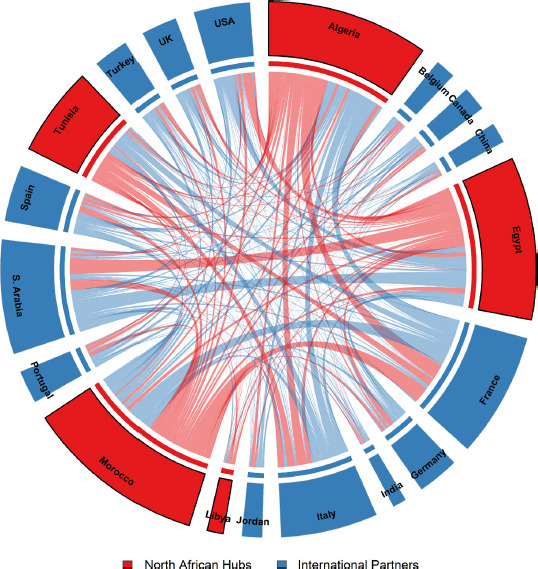
The analysis of the international collaboration network reveals a highly connected global landscape, with North African nations acting as the undeniable epicenters of research in this field (Figure 9). The chord diagram visually demonstrates the structure and intensity of these partnerships, distinguishing between the core North African Hubs and their International Partners.
The network is dominated by a strong Euro-Mediterranean collaborative axis. The thickest chords, representing the most frequent collaborations, are observed between the North African hubs, primarily Morocco, Algeria, Egypt, and Tunisia and several key European countries, most notably France, Spain, and Italy. This highlights a deeply rooted scientific relationship, likely driven by geographical proximity and shared research interests. Beyond this core, the network extends to form significant global partnerships with nations in the Middle East, Europe, Asia, and North America, including the USA.
The visual representation confirms that while the research scope is global, the North African countries serve as the central nodes from which the vast majority of international collaborations originate. This structure underscores their leadership and role as the primary drivers within this specific scientific domain.
Figure 9
The international research collaboration chord diagram. The width of each country’s arc on the circumference is proportional to its total research output. The width of the chords connecting the countries represents the strength of their collaboration. North African hubs are highlighted in red, and their international partners are in blue.
Discussion
The trajectory of scientific output depicted in this study reveals more than a simple quantitative increase in publications; it maps the intellectual maturation of a scientific discipline transitioning from descriptive documentation to mechanistic investigation. The three distinct phases identified in our analysis (Figure 1) mirror the classic pipeline of drug discovery from natural products, a process often termed ethnopharmacology or “reverse pharmacology” (Patwardhan et al., 2004). The initial Foundational Period (2000–2008), characterized by low publication volume, corresponds to the critical first step of this pipeline: the ethnobotanical documentation and initial cataloging of traditional knowledge. This era laid the groundwork by identifying the plant species used by local populations.
The subsequent Expansion Period (2009–2016) marks a significant shift toward scientific validation, as shown by the consolidation of research themes around standardized in vitro bioactivity screenings (Figure 7). The emergence of “antioxidant activity” as a dominant hub during this phase is particularly telling. It reflects the widespread adoption of cost-effective, high-throughput preliminary screening assays used to identify promising plant extracts with potential therapeutic relevance, as antioxidant potential is often linked to other bioactivities such as anti-inflammatory effects (Lobo et al., 2010). The current Maturity Period (2017–present) represents the most sophisticated phase of this evolution. The exponential surge in publications is driven by a clear pivot from studying whole extracts to identifying the specific molecules responsible for their effects, evidenced by the rise of “secondary metabolites” as a key theme. This reflects the field’s progression toward the ultimate goal of modern natural products research: the isolation and characterization of novel bioactive compounds for potential therapeutic development, a process fraught with challenges but essential for translating traditional knowledge into evidence-based medicine (Atanasov et al., 2015). This entire evolutionary arc is profoundly shaped by the unique and rich biodiversity of the North African flora, which serves as a vast natural library of potential therapeutic agents (Süntar, 2020).
Beyond its historical evolution, the contemporary intellectual core of the field is highly structured, mapping directly onto the sequential stages of the modern natural product discovery pipeline (Figure 6). This entire process begins with Cluster 1 (Red, “Ethnobotany and Ethnopharmacology Hub”), which represents the foundational fieldwork stage where traditional knowledge is documented to guide the selection of promising plant species. This ethnobotanical approach is a critical starting point that significantly increases the success rate of finding bioactive compounds compared to random screening (Fabricant & Farnsworth, 2001). This initial selection is refined and given a systematic, scientific basis by the work represented in Cluster 5 (Purple, “Aromatic Plants, Chemotaxonomy, and Biodiversity”). This theme provides the essential botanical and chemical context, allowing researchers to classify plants based on their chemical constituents (chemotaxonomy) and to understand the broader biodiversity landscape. This systematic approach enables a more targeted search for novel compounds within specific plant families, such as aromatic plants (Wink, 2015).
The knowledge gathered from these foundational stages flows directly into the extensive laboratory-based screening phase, represented by Cluster 2 (Green, “Phytochemical Analysis and In-Vitro Bioactivity”) and its specialized offshoot, Cluster 3 (Blue, “Essential Oils and Antimicrobial Research”). Here, crude extracts are tested using a battery of in vitro assays to validate traditional claims and identify biological activity (Sasidharan et al., 2011). Extracts showing promise then advance to Cluster 4 (Orange, “Preclinical In-Vivo Studies and Toxicology”), the crucial animal testing phase for validating efficacy and, critically, for assessing safety (Heinrich, 2010). The most advanced stages of the pipeline are represented by Cluster 6 (Teal, “Mechanistic and Enzymatic Studies”) and Cluster 7 (Pink, “Translational and Anticancer Research”), where research pivots toward understanding precise molecular mechanisms and exploring translational applications. This progression from plant to patient represents the ultimate goal of transforming natural products into evidence-based therapeutic agents (Newman & Cragg, 2020).
The social and geographical structure of this research field confirms North Africa’s central role as the primary engine of knowledge production on its own medicinal flora. The research landscape is dominated by the region’s own countries, where the analysis reveals a clear hierarchy of scientific leadership. Morocco and Algeria have established themselves as the undisputed scientific powerhouses, serving as the dominant regional hubs for this research domain (Figure 3). This leadership is a direct reflection of a potent combination: the region’s status as a biodiversity hotspot and a rich, living tradition of herbal medicine. This provides local researchers with a unique “ethnobotanical advantage,” allowing them to systematically investigate the very plants that form the basis of their local pharmacopeias (Saslis-Lagoudakis et al., 2011). This regional expertise is amplified and disseminated globally through a strong Euro-Mediterranean collaborative axis (Figure 9). The prominent partnership with European nations, particularly France and Spain, is likely driven by a combination of geographical proximity, shared historical ties, and targeted funding frameworks that foster scientific cooperation across the Mediterranean (Adams, 2013).
Internally, however, the field’s social fabric is characterized by a fragmented “archipelago” structure, with knowledge production concentrated within distinct research clusters or “invisible colleges” (Figure 8). This pattern, where collaboration is dense within groups but sparse between them, is a classic feature of specialized scientific fields (Crane, 1972). While this structure can be highly efficient, fostering deep expertise and rapid progress within a specific research niche, it also presents a potential challenge. The relative isolation between these clusters can create “structural holes” in the knowledge network, potentially slowing the diffusion of novel methods, discoveries, and best practices across the entire research community (Burt, 2004).
While this study provides the first comprehensive quantitative map of this research domain, several limitations inherent to the bibliometric methodology should be acknowledged to contextualize the findings. Firstly, the analysis was based exclusively on data retrieved from the Scopus database. While Scopus offers extensive coverage, this choice inevitably excludes publications not indexed therein, such as some local journals, books, and conference proceedings (Donthu et al., 2021). Secondly, our search was restricted to publications in the English language. This “language bias” is a significant limitation in bibliometric studies, as a substantial body of relevant research, particularly from a francophone region like North Africa, may have been published in other languages such as French or Arabic and thus omitted from our analysis (Mongeon & Paul-Hus, 2016). Thirdly, citation-based metrics can be influenced by various factors, including self-citation and the age of a publication, which are not always direct measures of research quality (Aksnes et al., 2019). Finally, it is crucial to remember that bibliometric analysis provides a macroscopic view of a field’s structure; it reveals broad patterns but does not assess the qualitative impact or scientific validity of individual articles (Zupic & Čater, 2015). Despite these limitations, this study offers a robust structural overview that provides a solid foundation for future qualitative reviews.
5. CONCLUSION
In conclusion, our analysis quantitatively demonstrates the maturation of North African medicinal plant research from a descriptive, ethnobotanical tradition into a sophisticated, chemically-focused discipline. However, the field’s intellectual structure (Figure 6) also illuminates a critical bottleneck: a significant gap between the vast body of preclinical research and the later stages of clinical validation. This “valley of death” in translation is a well-documented challenge in drug discovery, where a high percentage of promising preclinical candidates fail to become approved therapies (Hughes et al., 2011). To bridge this gap and fully realize the therapeutic potential of North Africa’s rich flora, future research must pivot in three key directions. First, there is an urgent need to move beyond isolated preclinical studies and toward designing rigorous, standardized randomized clinical trials to validate both the safety and efficacy of the most compelling plant extracts in humans (Atanasov et al., 2021). Second, instead of the traditional “one-compound, one-target” approach, the field should embrace network pharmacology. This systems-level approach uses computational tools to understand how the complex mixture of phytochemicals in an extract acts on multiple targets simultaneously, providing a more holistic view of its therapeutic effect (Hopkins, 2008). Finally, integrating modern “omics” technologies, particularly metabolomics, into this framework can accelerate the identification of active compounds and their molecular targets, paving the way for a new era of evidence-based, systems-level natural medicine (Verpoorte et al., 2008).
AUTHOR CONTRIBUTIONS
Conceptualization, Data Curation, Writing – Original Draft, Visualization: A.M.; Methodology, Formal Analysis, Writing – Review & Editing: A.M. and A.T.M.; Supervision: A.T.M.

