


1. INTRODUCTION
Catopsilia pomona (Fabricius, 1775), commonly known as the lemon emigrant, is one of the most widely distributed butterflies in the family Pieridae in tropical and subtropical Asia, extending from the Indian subcontinent, Southeast Asia, to Australia and some islands in the Pacific (Braby, 2005). This species has a high density in nature, is easily encountered in habitats ranging from plains to home gardens to secondary forests, and is often associated with plants of the Fabaceae family, especially Cassia and Senna species, which are the main plants during the larval stage (Ramesh et al., 2013).
This species is notable for its seasonal polyphenism, characterized by a marked difference in wing morphology and coloration between the wet and dry seasons. The characteristic wing color, ranging from bright yellow to green, is determined by a combination of pterin pigments and the ultra-microscopic structure of the wing scales (Chaianunporn and Khoosakunrat, 2018). This mechanism not only has evolutionary biological value but also has potential applications in bio-inspired optics research.
In addition to its ecological value, several studies have documented the activity of digestive enzymes, such as amylase, protease, and lipase, in the intestinal tract of this species, which contributes to explaining its nutritional adaptation to many different host plants (Saptarini et al., 2021). At the same time, studies on life cycles, life tables, and population dynamics also show that this species is sensitive to environmental change and can be used as a bioindicator to monitor biodiversity and climate impacts (Choudhury and Agarwala, 2013).
Despite being a common species and frequently mentioned in field surveys, no systematic review to date has comprehensively analyzed C. pomona. Existing studies often focus on individual aspects such as morphology, pigmentation, life cycle, or digestive enzymes. Therefore, a review is important to compile and analyze published results, thereby providing a comprehensive view of the species’ biology, ecology, and research potential. At the same time, this review also helps to identify knowledge gaps and guide future research related to wing structure, physiology, host plant relationships, and the species’ role in agricultural and natural ecosystems.
This review aims to (i) provide a comprehensive scientific basis on the morphology, pigmentation, life cycle, and biology of C. pomona; (ii) synthesize research results on digestive physiology, nutritional relationships with host plants, and ecological roles of species; and (iii) point out limitations and challenges, and suggest new research directions in the future.
2. METHODOLOGY
To synthesize information on the chemical composition, biological characteristics, digestive enzymes, nutritional value, and potential food applications of C. pomona, we conducted a systematic literature review. The search was conducted on reputable scientific databases such as Web of Science, Scopus, PubMed, etc.
The selected documents included preclinical and clinical studies, published in the period 1999–2023. The main search keywords were: “Catopsilia pomona”, “digestive enzymes”, “edible pupae”, and “food applications”.
Works that did not directly focus on the identified aspects were excluded to ensure the accuracy and depth of the review.
3. BIOLOGICAL CHARACTERISTICS OF C. POMONA
C. pomona is a butterfly common in tropical Asia, possessing a typical complete metamorphosis life cycle (Figure 1). The entire cycle from egg to adult typically lasts 22–29 days, with the duration of each stage greatly influenced by environmental conditions such as temperature and humidity (Arju et al., 2010). This adaptation allows them to rapidly reproduce and grow their populations.
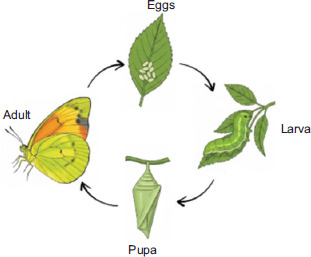
The process begins when females lay their eggs singly on host plants in the Fabaceae family, mainly species in the Senna and Cassia genera, such as Senna siamea (Vị et al., 2021). The eggs are upright, diamond-shaped, change from creamy white to pale yellow, and hatch after about 2–4 days (Pandey, 2006). Newly hatched larvae undergo five molts over a period of 8–10 days. They exhibit a high degree of specialization, feeding almost exclusively on the leaves of their original host plant, a characteristic that has earned them the name “Sâu muồng” (C. pomona) in the local community (Vị et al., 2021). As adults, the larvae can reach 45–50 mm in length, with a dark green colour and white stripes along the body.
The subsequent pupal stage lasts 5–8 days. The pupa has the characteristic angular shape of the Pieridae family, with a pale green or yellow-green colour that effectively camouflages it against the foliage. The adult butterfly then emerges with a wingspan of 60–70 mm. Colour polymorphism is observed, often in lemon-yellow or white forms, with males tending to be brighter than females (Dunn, 2021). They are diurnal, sometimes migratory in flocks, and act as important pollinators.
In summary, the short life cycle and the strong dependence on specific host plants help explain the widespread distribution and success of C. pomona. However, these same characteristics can also make it a local pest of ornamental or shade legumes (Van der Poorten et al., 2016). In fact, in Catopsilia species, several studies have documented that larvae cause severe defoliation of Senna species, with leaf infection rates of 44–96% (Meena et al., 2023).
4. PIGMENTATION OF C. POMONA
One of the most striking features of C. pomona is its distinctive yellow–lime green wing color, which is due to the presence of pterin pigments combined with the microstructure of the wing scales (Mishra et al., 2019).
Spectroscopic studies have shown that the wings of the species contain many different forms of pterin, a group of heterocyclic compounds that strongly absorb in the ultraviolet region and reflect strongly in the visible region, thereby creating a bright yellow to yellow-green color. Notably, in the wing scales of C. pomona, some nanostructures play a role in diffusing and refining the reflected wavelength, increasing the brightness of the color and creating differences between seasonal variations (Mishra et al., 2019; Mishra et al., 2017).
Seasonal polyphenism is evident in this species. During the rainy season, individuals typically have brighter wing coloration, while in the dry season the wings are pale green, a strategy thought to increase camouflage and reduce predation risk (Kunte, 2000). Both genetic factors and environmental conditions, such as temperature, humidity, and light intensity, influence this change.
In addition, the study of the coloration mechanism of C. pomona has value beyond the field of entomology. The results on the interaction between pterin pigments and nanostructures in wing scales are opening the way for the development of bio-inspired photonic materials with applications in biosensor fabrication, anticounterfeiting materials, and display technology (Mishra et al., 2019).
However, current studies have focused only on describing pigments and optical structures, while the molecular basis of pterin biosynthesis pathways, genes regulating wing scale morphology, and seasonal regulation mechanisms remains unclear. This is an important gap that needs to be addressed in the future to better understand the relationships among genetics, physiology, and environment in determining species-specific color.
5. DIGESTIBILITY OF C. POMONA
Insect digestion relies on the coordination of several enzymes to break down macromolecules in food into simpler forms for absorption. In C. pomona, studies have shown the presence and strong activity of three main groups of digestive enzymes: amylase, protease, and lipase (Saptarini et al., 2021).
Amylase acts as a catalyst, hydrolyzing starch and other polysaccharides stored in host leaves into simple sugars, providing a quick source of energy for the larvae. Amylase activity in C. pomona was recorded to be high during the larval stage, consistent with the energy requirements for rapid development (Choudhury, 2011).
Protease plays a role in breaking down proteins in leaf tissues into peptides and free amino acids. Protease activity plays an important role in providing raw materials for the body’s protein synthesis, supporting growth and molting. Experimental results show that protease activity in C. pomona is flexibly regulated depending on the type of host leaf (Saptarini et al., 2021).
Lipase is responsible for the breakdown of lipids, an important source of stored energy, into glycerol and fatty acids. Although the lipid content of host leaves is not as high as that of carbohydrates and proteins, lipase activity has been observed, playing an essential role in energy balance and cell membrane structure (Saptarini et al., 2021).
Overall, the combination of amylase, protease, and lipase in the digestive system makes C. pomona well adapted to a diet from the Fabaceae family, which is rich in secondary metabolites that can inhibit digestion. These enzymes not only ensure the efficient metabolism of nutrients but also reflect the physiological adaptation of this butterfly to its habitat and host plants.
6. NUTRITIONAL COMPOSITION OF C. POMONA
A study conducted in Gia Lai province (Vietnam) analyzed the nutritional composition of C. pomona pupae with the following results: protein content was 12.67 g per 100 g on a dry weight basis (DW), lipid was 14.62 g/100 g DW, amino acid nitrogen index was 1.68 g/100 g DW, total minerals was 7.18 g/100 g DW, and total phosphorus was 41.00 mg/100 g DW (Vị et al., 2021).
Table 1 shows that the protein content of C. pomona pupae (12.67 g/100 g DW) was significantly lower than that of other pupae (Bombyx mori, Samia ricinii, and Apis mellifera) (Vị et al., 2021; Rumpold and Schlüter, 2013; Longvah et al., 2011 Ghost et al., 2016). However, compared to many other materials (rice, wheat, etc.), this is still a very remarkable source of protein.
Table 1
Nutritional composition of some pupae (g/100 g DW).
| C. pomona (Vị et al., 2021) | Bombyx mori (Rumpold and Schlüter, 2013 ; Tassoni et al., 2022) | Samia ricinii (Longvah et al., 2011) | Apis mellifera (Ghosh et al., 2016) | |
|---|---|---|---|---|
| Protein | 12.67 | 48.7–58 | 54.6–54.8 | 45.9 |
| Lipid | 14.62 | – | 25.00–26.20 | 16 |
| Nitrogen amino | 1.68 | – | – | – |
| Mineral | 7.18 | – | – | – |
| Total phosphorus | 0.041 | 0.0056–0.47 | 0.570–0.584 | 0.9 |
In addition, the lipid content of ~14.62 g/100 g DW is also relatively high, depending on the species and processing method. Lipids provide important energy, making pupae not only a source of protein but also a source of integrated energy. The lipid content (14.62 g/100 g DW) is lower than that of Samia ricinii (25.00–26.20 g/100 g DW) and comparable to that of Apis mellifera (16 g/100 g DW), confirming its value as a significant energy source (Longvah et al., 2011; Ghost et al., 2016). Total minerals (7.18 g/100 g DW), especially phosphorus (41 mg/100 g DW), indicate that pupae provide macrominerals necessary for basic metabolism, bone structure, and cellular function (Vị et al., 2021).
However, more detailed data are not yet available, such as essential amino acid composition (% total amino acids), vitamin composition—both fat-soluble, and water-soluble—trace mineral content (e.g. iron, zinc, magnesium, calcium), as well as the digestibility and bioavailability of protein/lipids in pupae.
Although initial results indicate that C. pomona is a valuable nutritional source, particularly for lipid content, there remain significant research gaps that need to be addressed to assess its potential fully. To fully assess the potential of C. pomona pupae, future studies need to focus on the following key gaps: (1) protein quality (essential amino acid composition and digestibility); (2) vitamin and trace mineral content; and (3) food safety (contamination and allergen risk) before widespread application.
Therefore, C. pomona pupae can be considered a nutritious food source, especially in terms of protein and lipid, but further studies are needed to fully evaluate its nutritional value (protein quality, vitamins, food safety, etc.) if it is to be widely used in the human diet.
7. APPLICATIONS OF C. POMONA
According to Vị et al. (2019), C. pomona pupae are used in traditional cuisine by local people in the Central Highlands of Vietnam, mainly stir-fried with lemongrass and chili or steamed with ginger. This simple cooking method retains the natural fatty flavor and nutritional content of the pupae. These insects are not only consumed in households but also sold in highland markets as a protein-rich food, contributing to the diversification of protein sources. When compared to species of the same family Pieridae, such as C. crocale and C. pyranthe, which have also been noted for their food value in some rural communities in South Asia (Tukshipa et al., 2023), it can be seen that the Catopsilia species group, in general, is gaining increasing attention as an alternative source of nutrition. Overall, these applications reflect the potential for sustainable exploitation of insects in the family Pieridae for food, while opening avenues for the development of ready-to-eat products or dietary supplements rich in protein.
8. CHALLENGES OF C. POMONA
Although C. pomona is not considered a serious economic pest, it does cause some damage. Its larvae can cause heavy and persistent defoliation of ornamental legumes in gardens, affecting their aesthetic value (Rienks, 1999). In Vietnam, caterpillars and pupae have long been a familiar ingredient in the Ede cuisine. However, for many people who have never been exposed to insects, using insects as food often elicits apprehension, becoming a major barrier to expanding applications and developing commercial value.
Some initial studies in Vietnam have focused only on the basic nutritional composition of C. pomona pupae, showing that the protein, lipid, and some essential mineral contents are quite high, with the potential to become a nutritious food source. However, to date, there has been no in-depth work on biological properties or functional activities (such as antioxidant, anti-inflammatory, or antibacterial activities), nor has there been a comprehensive toxicity study to assess the safety of long-term use.
In addition, the exploitation of C. pomona in nature remains spontaneous, lacking sustainable farming practices and population management. This leads to difficulties in standardizing raw materials for research and commercialization. Another challenge is changing social perceptions, although edible insects are being seen as an alternative protein source, in Vietnam, they are still popular only among some ethnic minority communities. Limited acceptance among urban consumers means the potential applications of C. pomona pupae are not fully realized.
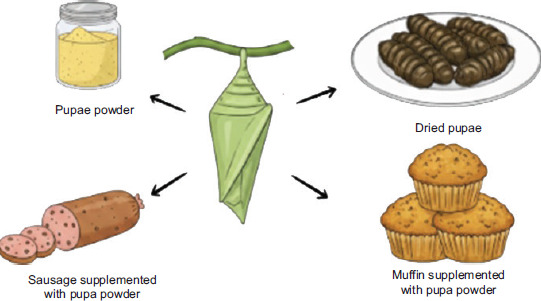
However, given its potential and short life cycle, we can exploit this species in many fields, especially in food technology, as with other insects: pupa powder, dried pupa, or products supplemented with insect powder, such as cakes and sausages (Figure 2). In the chemical field, it is possible to extract substances containing pigments.
Thus, to develop the value of C. pomona in the food and pharmaceutical sectors, more in-depth research on its biochemical composition, biological activity, and safe processing procedures, combined with communication to raise social awareness, is needed. This not only contributes to the preservation of indigenous knowledge but also opens new avenues for exploiting edible insect resources.
9. CONCLUSION
The overview shows that C. pomona is an insect species with many values both in terms of biology and practical applications. Not only is this species an interesting research subject in the fields of pigmentation, life cycle, and digestive physiology, but it is also notable for its rich nutritional composition, promising it could become a potential food source. The exploitation of C. pomona pupae not only diversifies protein sources but also opens new directions for developing nutritious insect-based food products. However, more in-depth research on safety, processing technology, and commercial development potential is needed to effectively and sustainably exploit the value of the species in the future.
AUTHOR CONTRIBUTIONS
Research concept and design: P.T.Q., L.P.T.Q.; Collection and assembly of data: L.B.B.P, P.T.Q.; Data analysis and interpretation: P.T.Q., L.P.T.Q.; Writing the article: L.P.T.Q., L.B.B.P.; Critical revision of the article: P.M.H.; Final approval of the article: L.P.T.Q. All authors have read and agreed to the published version of the manuscript.

