About the Journal
Editorial Board
Editorial Office and Publisher
Ownership
Article Processing Charge
Open Access and Licensing
Personal Data Protection
Terms and Conditions: Cookie policy and Privacy policy
Copyright and Copyright Transfer Agreement
Visagaa Publishing House Repository Policy
Visagaa Publishing House CrossMark Policy
The Initiative for Open Citations (I4OC)
Archiving
Plagiarism Policy
Online first
Current issue
Archive
Ethics Statements for Natural Resources for Human Health
Ethical Guidelines
Post-Publication Policies
Responsibilities of Editors and Publishers
Conflict of Interest Statements for Natural Resources for Human Health
Human and Animal Rights Policy
Complaints and Appeals Policy
Allegations of Research Misconduct Policy
Authorship and Contributorship Policy
Publication Ethics and Malpractice Policy
Ethics approval and informed consent
Guidelines for the Use of Generative AI and AI-Assisted Technologies in Manuscripts for Natural Resources for Human Health
For authors
Instructions for Authors
Submitting manuscript – step by step
Authorship and Contributor Guidelines
For reviewers
The peer-review process
Recognition for Reviewers
Visagaa Author Services
About the Journal
Editorial Board
Editorial Office and Publisher
Ownership
Article Processing Charge
Open Access and Licensing
Personal Data Protection
Terms and Conditions: Cookie policy and Privacy policy
Copyright and Copyright Transfer Agreement
Visagaa Publishing House Repository Policy
Visagaa Publishing House CrossMark Policy
The Initiative for Open Citations (I4OC)
Archiving
Plagiarism Policy
Ethics Statements for Natural Resources for Human Health
Ethical Guidelines
Post-Publication Policies
Responsibilities of Editors and Publishers
Conflict of Interest Statements for Natural Resources for Human Health
Human and Animal Rights Policy
Complaints and Appeals Policy
Allegations of Research Misconduct Policy
Authorship and Contributorship Policy
Publication Ethics and Malpractice Policy
Ethics approval and informed consent
Guidelines for the Use of Generative AI and AI-Assisted Technologies in Manuscripts for Natural Resources for Human Health

| eISSN: | 2583-1194 |

ORIGINAL RESEARCH PAPER
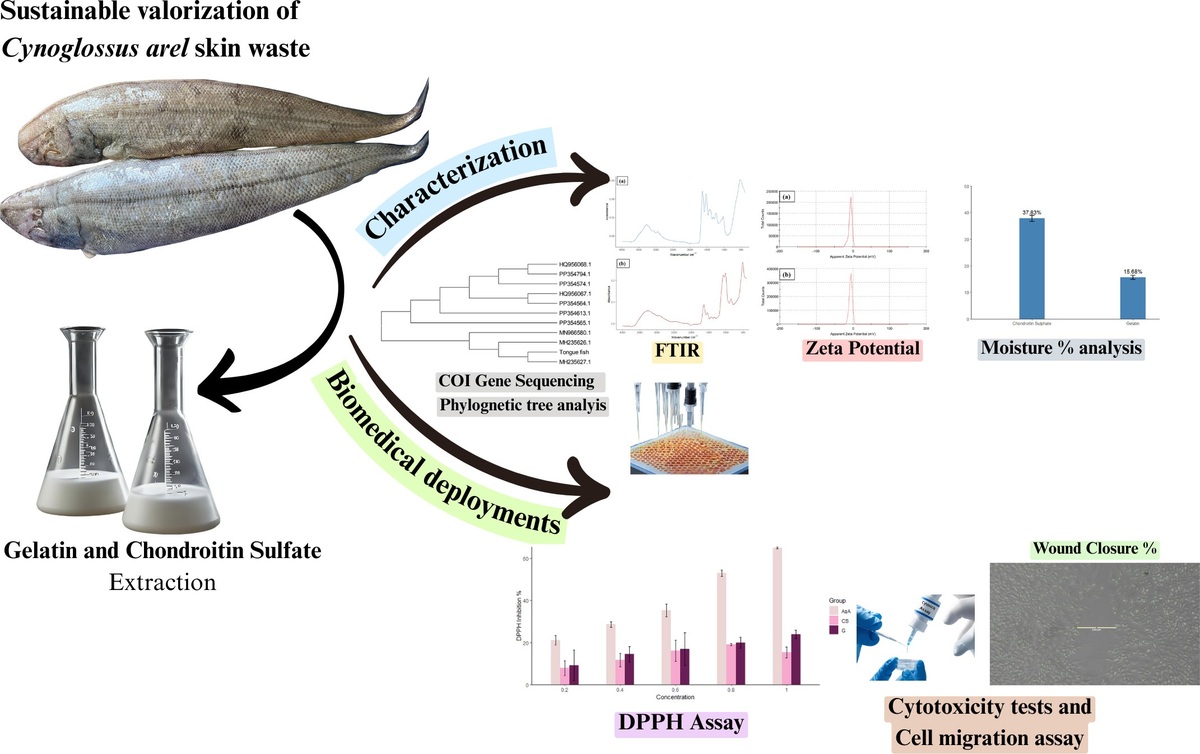
Sustainable valorization of Cynoglossus arel skin waste into functional biopolymers: extraction, characterization, and biomedical applications in dermal cell regeneration
1
Department of Life Sciences, CHRIST (Deemed to be University), India
Submission date: 2025-09-27
Final revision date: 2025-11-18
Acceptance date: 2026-01-28
Online publication date: 2026-06-30

KEYWORDS
TOPICS
ABSTRACT
The growing problem of fishery waste poses a significant environmental concern and represents a valuable untapped source of biomaterials that can be converted into useful resources. This research aims to achieve the sustainable valorization of Cynoglossus arel waste. We extracted and characterized gelatin and chondroitin sulfate from fish skin and rigorously analyzed them to assess the integrity of their functional groups and their colloidal stability. The findings further verify that the gelatin has appropriate structure characteristics, as supported by tests for moisture content and gelation. Meanwhile, chondroitin sulfate was shown to be sulfated using Toluidine Blue, Safranin O, and Methylene Blue precipitation tests. Following their confirmatory tests, the antioxidant activities of the biopolymers were examined by the DPPH radical scavenging assay. The gelatin and chondroitin sulfate exhibited moderate antioxidant activity, suggesting their potential to combat oxidative stress. Their potential for biomedical applications, especially in wound healing, was evaluated using cell migration assays with normal human dermal fibroblast cells. When applied at specific concentrations, the biopolymer extracts significantly improved cell migration and accelerated wound healing compared with the control group. These results illuminate the high potential for utilizing Cynoglossus arel fish waste to produce bioactive compounds with significant therapeutic uses. The research establishes the dual advantage of valorizing marine waste and producing low-cost, natural biomaterials for regenerative medicine, especially for dermal repair.
Share
RELATED ARTICLE
| eISSN: | 2583-1194 |

We process personal data collected when visiting the website. The function of obtaining information about users and their behavior is carried out by voluntarily entered information in forms and saving cookies in end devices. Data, including cookies, are used to provide services, improve the user experience and to analyze the traffic in accordance with the Privacy policy. Data are also collected and processed by Google Analytics tool (more).
You can change cookies settings in your browser. Restricted use of cookies in the browser configuration may affect some functionalities of the website.
You can change cookies settings in your browser. Restricted use of cookies in the browser configuration may affect some functionalities of the website.
