


1. Introduction
Purple maize (Zea mays L.) is a traditional pigmented variety of great agroecological, cultural, and nutraceutical importance in the Americas, particularly in Mexico, where its cultivation dates back centuries and represents a fundamental element of regional diet and identity. This variety is characterized by its high content of phenolic compounds, mainly anthocyanins, which confer its distinctive purple color, potent antioxidant activity, and health-promoting properties, including anti-inflammatory, antidiabetic, and anticancer effects (García Reyes et al., 2022; Tepixtle Colohua, Reyes Trejo & Saucedo, 2025; Kim et al., 2023; Rabanal Atalaya & Medina Hoyos, 2021). Beyond its cultural and dietary relevance, purple maize represents a valuable option for the agroindustry and technological innovation, offering a high-value product with multiple functional applications (Saltos et al., 2021; García Reyes et al., 2022; Kim et al., 2023).
The accumulation of polyphenolic compounds, along with the development and functional integrity of photosynthetic pigments such as chlorophylls and carotenoids, are dynamic processes finely regulated by physiological, genetic, and environmental factors. The proper synthesis and maintenance of these pigments are essential for efficient light energy capture, biomass production, and plant growth; therefore, their modulation directly impacts crop productivity and quality (Elango et al., 2023; Qaderi, Martel & Strugnell, 2023; Zahara et al., 2024). Photosynthetic pigment concentrations and anthocyanin levels also respond to stress conditions, highlighting their role in plant defense and secondary metabolism (Ogunsiji, 2023; Arruda et al., 2023; Rashid et al., 2025).
Among the substances employed to improve crop growth and stress tolerance, salicylic acid (AS) has gained considerable attention. AS is a key phytohormone regulating growth, photosynthesis, pathogen defense, and stress tolerance, and it modulates both primary and secondary metabolism (Khan, Poor & Janda, 2022; Yang et al., 2023). Across diverse crops—including legumes, cucurbits, cereals, and solanaceous species—exogenous AS application has been shown to enhance chlorophyll and carotenoid content, improve water relations, increase biomass, and activate antioxidant defenses under salinity, drought, and other stresses (Rashid et al., 2025; Ogunsiji, 2023; Alyemeni, 2014). In particular, AS treatments have been linked to improved pigment stability, photosynthetic efficiency, and the accumulation of bioactive compounds in horticultural and agronomic crops (Smith & Jones, 2019; Shasmita et al., 2019; Li et al., 2022).
In the context of purple maize, the interaction between AS and anthocyanin biosynthesis, as well as chlorophyll and carotenoid production, remains relatively underexplored. In vitro culture on solid media provides a controlled and precise platform to evaluate the effects of AS on growth, structural health, photosynthetic efficiency, and secondary metabolite accumulation, allowing detailed analysis of its impact on plant development (Larqué Saavedra et al., 2010; Dzib Ek et al., 2021; Serrano Peraza & Rivas Flores, 2023). The present study evaluated the effect of different AS concentrations on growth, physiological health, and photosynthetic pigment production in purple maize seedlings cultured in vitro on agar, aiming to provide evidence supporting its use as a biostimulant and as an innovative strategy in modern agrotechnology.
2. Methods
Purple maize seeds were obtained from local farmers in Ich-Ek (Campeche, Mexico). Seed cleaning and surface disinfection followed conventional procedures widely applied in physiological and agronomic experiments involving Zea mays, where sterilization steps are required to ensure aseptic germination and to avoid microbial interference during early seedling development, as noted in studies evaluating salicylic acid (AS) effects under controlled conditions (Tucuch-Haas et al., 2016; Zamaninejad et al., 2013).
Seeds were washed, cleaned of mechanical impurities, and subsequently disinfected by immersion in a 2% NaClO solution for 10 min, followed by several rinses in sterile distilled water, consistent with the aseptic preparation commonly reported in in vitro or semi-in vitro assays employing maize or other horticultural species exposed to AS (Larqué-Saavedra et al., 2010; Sánchez-Chávez et al., 2011).
The culture medium consisted of a 0.5% (w/v) agar-agar suspension, previously dissolved by heating to boiling and sterilized at 121 °C for 15 min. Solid culture media have been routinely employed in AS-related germination and early growth studies, allowing precise control of root, hypocotyl, and leaf development in seedlings (Dzib-Ek et al., 2021; Valdez Sepúlveda et al., 2015).
Salicylic acid was dissolved in sterile distilled water to prepare four experimental treatments: 0 mg L–1 (solvent control), 0.5 mg L–1, 1.5 mg L–1, and 5.0 mg L–1. The use of graded AS doses is consistent with literature documenting its regulatory roles in germination, photosynthesis, nutrient uptake, and biomass accumulation in several crop species, including tomato, chili, maize, and bean (Anchondo-Aguilar et al., 2011; Larqué-Saavedra et al., 2010; Serrano-Peraza & Rivas-Flores, 2023; Tucuch-Haas et al., 2017).
Once the medium reached a workable temperature but prior to solidification, AS was incorporated to achieve the final concentrations in each treatment. Aliquots of 20 mL were dispensed aseptically into sterile culture vials, and a single seed was placed in each vial. The experimental design—using one seed per vessel to prevent competition effects—follows approaches used in controlled AS experiments evaluating individual seedling responses (Tucuch-Haas et al., 2016; Dzib-Ek et al., 2021).
Cultures were maintained under controlled environmental conditions: 27 °C, 78% relative humidity, and a 12-h light/12-h dark photoperiod using cool-white LED illumination. Such controlled conditions allow the isolation of AS effects from environmental variability and are consistent with studies examining AS-regulated growth, photosynthetic pigments, and metabolic adjustments (Li et al., 2022; Qaderi et al., 2023; Lefevere et al., 2020).
After 10 days of culture, seedlings were harvested for morphometric and biomass assessments. Root, stem, and leaf lengths, as well as leaf area, were measured from high-resolution digital images analyzed with ImageJ®. Morphometric quantification from digital imagery is widely used in AS-related seedling studies to detect subtle growth responses (Rangel-Sánchez et al., 2010; Vázquez Díaz et al., 2016).
Fresh biomass was recorded immediately after harvesting. Dry biomass was obtained after oven-drying tissues at 70 °C to constant mass, following standard procedures adopted in studies evaluating AS-induced changes in biomass, photosynthetic performance, nutraceutical quality, or metabolic traits (Sánchez-Chávez et al., 2011; Tucuch-Haas et al., 2017; Zamaninejad et al., 2013).
Photosynthetic pigments were quantified from methanolic extracts. Absorbances at 663, 645, and 470 nm were measured spectrophotometrically, and chlorophyll a, chlorophyll b, and carotenoids were calculated using established equations widely applied in plant physiology and in studies assessing AS effects on pigment biosynthesis and photochemical functioning (Elango et al., 2023; Shasmita et al., 2019; Zahara et al., 2024).
2.1. Statistical analysis
All parametric data were tested for normality (Shapiro–Wilk) and homogeneity of variance (Levene). A one-way ANOVA was applied to evaluate the effect of AS concentration on all dependent variables. When significant differences were observed (p < 0.05), Tukey’s post hoc test was used for pairwise comparisons. The adoption of these statistical procedures is consistent with analytical approaches in SA-plant research involving controlled experiments with multiple treatments (Anchondo-Aguilar et al., 2011; Sánchez-Chávez et al., 2011; Saltos et al., 2021). Statistical analyses were performed in GraphPad Prism 10.5.0 for Mac®.
3. Results
The results (Table 1) show that AS application at different concentrations had a notable effect on the evaluated biometric and physiological parameters compared to the control. Seedlings treated with AS showed increases in fresh and dry weight, with the 1,5 mg L-1 treatment achieving the highest values in both parameters. Leaf moisture slightly decreased as AS concentration increased, which was reflected in a relatively stable dry weight/fresh weight ratio among treatments. Leaf area significantly increased at 0,5 and 1,5 mg L-1, suggesting stimulation of leaf growth, while specific leaf density, an indicator of dry matter concentration per unit area, remained similar across treatments, with slight variations that did not alter the overall trend.
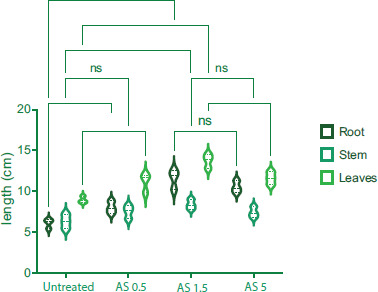
Salicylic acid (AS) exerted a significant effect on the growth of Zea mays seedlings, exhibiting a dose-dependent response. Low AS concentrations, particularly in the 0.5 and 1.5 mg L-1 treatments, notably promoted growth, reflected by statistically significant increases in root and leaf length compared to the untreated control (Figure 1); no statistically significant differences were observed for stem length. These results suggest that AS at moderate concentrations acts as a physiological stimulator, enhancing the initial development of the crop. However, increasing the salicylic acid concentration to 5 mg produced adverse effects on growth, with a marked reduction in the evaluated biometric variables, indicating a possible toxic effect or excessive stress on seedlings at this high dose.
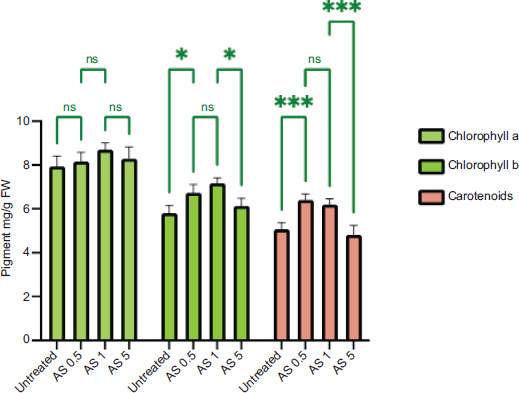
Chlorophyll a, chlorophyll b, and carotenoid concentrations showed a significant increase in seedlings treated with 0.5 and 1.5 mg L-1 of salicylic acid, with carotenoid levels exhibiting particularly pronounced increases compared to the control (Figure 2). In contrast, the 5 mg treatment markedly reduced the synthesis of photosynthetic pigments.
Table 1
Effect of different salicylic acid (AS) concentrations on biometric and physiological parameters of purple maize seedlings at 10 days of culture (source: authors’ own data).
4. Discussion
The results obtained show a differential effect of salicylic acid (AS) on the biometric and physiological variables evaluated in the culture compared to the untreated control. In general terms, the fresh weight of plants treated with AS was higher than that of the control group; however, at the highest concentration, fresh weight decreased, approaching the control value. This suggests that moderate doses of salicylic acid may stimulate growth or water retention in tissues, whereas high concentrations could induce mild stress or toxicity, limiting development. This is consistent with data on plant tissue moisture content, which showed a slight progressive decrease as AS concentration increased, potentially related to greater maturation or cell wall hardening, or to osmotic adjustment mechanisms induced by salicylic acid, known for its role in regulating responses to water stress (Tucuch-Haas et al., 2017; Zamaninejad et al., 2013).
Dry weight showed a significant increase with AS treatment, indicating greater accumulation of dry biomass and possibly an increase in the synthesis of structural or metabolic compounds, reflecting improved carbon fixation efficiency. These results are complemented by the observed increase in leaf area at low and medium AS doses, suggesting a promoting effect on leaf expansion and the total photosynthetic capacity of the crop. Regarding the dry weight/fresh weight ratio, no marked differences were observed between treatments. This indicates that despite variations in fresh and dry weight, the proportion of water to dry matter in the tissue remained relatively constant, suggesting that salicylic acid does not substantially alter the relative water balance of leaves but rather influences the total biomass (Tucuch-Haas et al., 2017; Zamaninejad et al., 2013).
Furthermore, specific leaf density (mg/cm2) is an indicator of tissue mass per unit leaf area and showed a significant increase in all AS treatments compared to the control, with the highest value observed in the 5.0 mg L-1 AS treatment. This increase suggests that salicylic acid induces greater allocation of dry matter to leaf structure, probably reinforcing cell walls or increasing the synthesis of structural compounds, which may translate into greater resistance to environmental stress or pathogens.
Overall, the data suggest that salicylic acid at low to moderate concentrations can promote growth and biomass accumulation in the crop, improving parameters such as dry weight and leaf area. However, at high concentrations, it may reduce fresh weight and moisture, likely due to stress effects, while the maintenance or increase in leaf density may indicate structural adaptation. These findings are consistent with previous studies showing a regulatory effect of salicylic acid on plant growth and stress response, highlighting the importance of dose for optimal benefits (Tucuch-Haas et al., 2016; Tucuch-Haas et al., 2017).
The results also show that AS has a clear dose-dependent effect on the growth and production of photosynthetic pigments in in vitro-cultured purple maize (Zea mays) seedlings. Moderate concentrations (0.5 and 1.5 mg L–1) significantly promoted root and leaf elongation, whereas the high dose (5 mg L–1) caused a marked reduction in the evaluated biometric variables. This behavior aligns with the biphasic nature of AS reported in various species, describing the biostimulatory effect at low doses and phytotoxic or oxidative stress effects at high doses (Valdez et al., 2015; Vázquez et al., 2016). At optimal concentrations, AS can stimulate cell division and elongation through the activation of signaling pathways regulating structural protein synthesis, nutrient uptake, and osmotic balance, while also modulating the expression of genes related to antioxidant enzymes such as superoxide dismutase and catalase, thereby strengthening defense mechanisms against both biotic and abiotic stress (Lefevere, Bauters, & Gheysen, 2020; Li, Sun, & Liu, 2022). This physiological strengthening translates into better establishment and initial seedling development, which is crucial for producing healthy seedlings for high-tech agricultural systems.
The significant increase in chlorophyll and carotenoid concentration in seedlings treated with 0.5 and 1.5 mg L-1 AS suggests a positive effect on the integrity and functionality of the photosynthetic apparatus. In the case of carotenoids, their increase is relevant not only for photoprotection against excess radiation and reactive oxygen species but also for their nutraceutical value, providing antioxidant properties beneficial for human and animal health (Valdez et al., 2015; Vázquez et al., 2016). Conversely, the drastic decrease in photosynthetic pigments at the 5 mg L-1 dose confirms that excessive AS concentrations can interfere with biosynthetic pathways or accelerate the oxidative degradation of pigments, thereby compromising photosynthetic efficiency, possibly due to the overproduction of reactive oxygen species damaging membrane lipids, proteins, and photosystem II complexes if antioxidant defense is insufficient (Shasmita et al., 2019).
These findings reinforce the potential of AS as an agrotechnological tool to improve high-value crops such as purple maize. Controlled application could be integrated into micropropagation protocols, nursery seedling production, or pre-transplant treatments to optimize physiological health and increase nutraceutical compound content (Valdez et al., 2015; Vázquez et al., 2016; Gaucin et al., 2025). However, the dose-dependent nature of its action requires careful definition of optimal application ranges through complementary studies conducted both in vitro and under field conditions.
From a sustainability perspective, the use of natural regulators such as AS at low concentrations represents a strategy compatible with precision agriculture and functional food production, particularly for purple maize, to increase pigments such as anthocyanins and carotenoids under proper hormonal management, thereby strengthening agro-food value chains oriented toward health and generating both economic and social benefits (Anchondo-Aguilar et al., 2011; Vázquez et al., 2016).
Overall, this study provides evidence supporting the use of salicylic acid as a viable agronomic strategy to improve the growth and physiological quality of purple maize seedlings, provided that moderate concentrations are used to avoid toxic effects. Future research could focus on evaluating the effect of these optimal doses at later developmental stages and under field conditions, as well as further investigating the molecular mechanisms regulating these responses.
5. Conclusion
Exogenous application of salicylic acid exhibited a dose-dependent effect on growth and the production of photosynthetic pigments in purple maize (Zea mays) seedlings. Low to moderate concentrations significantly promoted root and leaf development, as well as increased chlorophyll and carotenoid synthesis, potentially enhancing photosynthetic capacity and antioxidant defense in the plants. In contrast, a high dose proved detrimental, inhibiting growth and reducing pigment concentrations, indicating a toxic effect. These findings suggest that salicylic acid can serve as an effective tool to improve the physiology and quality of purple maize seedlings when applied at appropriate doses. Further studies are recommended to validate these effects at later developmental stages and under field conditions.
Author Contributions
R.M.A.: Research concept and design, Collection and/or assembly of data, Data analysis and interpretation, Writing the article, Critical revision of the article, Final approval of the article; M.M.G.M.: Research concept and design, Data analysis and interpretation, Critical revision of the article, Final approval of the article; F.G.O.B.: Collection and/or assembly of data, Data analysis and interpretation, Writing the article, Final approval of the article; M.E.M.E.: Data analysis and interpretation, Writing the article, Final approval of the article; R.E.C.M.: Collection and/or assembly of data, Data analysis and interpretation, Writing the article, Final approval of the article; D.E.E.G.: Collection and/or assembly of data, Writing the article.

