

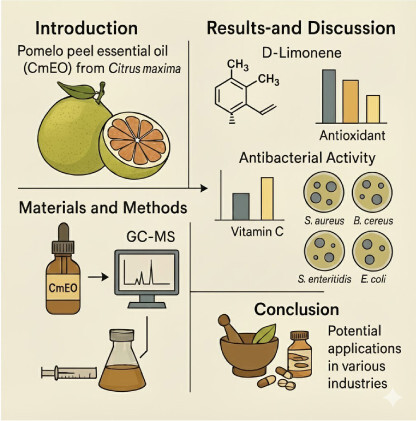

1. INTRODUCTION
Pomelo (Citrus maxima), a member of the Rutaceae family, is widely cultivated in tropical and subtropical regions, including Vietnam. Its peel, a byproduct of fruit processing, contains high concentration of essential oils (EOs) with valuable biological activities and economic potential. In Vietnam, Ben Tre province is one of the largest pomelo-growing areas, generating large volumes of peel wastes that remain underutilized in value-added applications such as EO extraction (Van-Hoang, 2015).
Pomelo peel EO is primarily composed of D-limonene and other monoterpenes, which have been reported to possess antibacterial, antioxidant, and anti-inflammatory properties (Rana and Blazquez, 2012; Shaaban et al., 2012). These properties make it a potential candidate for applications in the food, cosmetic, and pharmaceutical industries (Seyyedi-Mansour et al., 2024). Moreover, the EO exhibits aroma-enhancing properties, making it suitable for fragrance-related uses.
In traditional medicine, various parts of the pomelo plant are used for treating headaches, colds, and microbial infections (Dao et al., 2021). Recent studies have also highlighted its potential for mood enhancement and neurological benefits, suggesting a broader therapeutic scope (Badalamenti et al., 2022).
Despite its wide cultivation and industrial relevance, pomelo peel in Ben Tre remains underutilized in value-added applications such as EO extraction. There is currently a lack of scientific data regarding the chemical profile and biological activities of pomelo peel EO (CmEO) from this region, which hinders its potential application in food preservation, cosmetics, and pharmaceuticals. Given the increasing demand for natural bioactive ingredients and the importance of regional characterization, this study was designed to fill this knowledge gap. Specifically, it aims to investigate the chemical composition, physicochemical properties, antioxidant capacity, and antibacterial activity of CmEO extracted from C. maxima cultivated in Ben Tre province.
2. MATERIALS AND METHODS
2.1. Sample collection and essential oil extraction
The essential oil from pomelo peel (CmEO) was obtained from C. maxima fruits, a pomelo variety grown and harvested in Ben Tre province, Vietnam. The distillation process yielded an extraction efficiency of approximately 1.8%. The extracted EO was stored in dark glass vials at room temperature to preserve its quality and properties.
2.2. Bacterial strains
This research utilized four bacterial strains: two Gram-positive bacteria, Staphylococcus aureus (ATCC 33591) and Bacillus cereus (ATCC 11778), as well as two Gram-negative bacteria, Escherichia coli (ATCC 25922) and Salmonella enteritidis (ATCC 13076). These bacterial strains were obtained from the Institute of Biotechnology and Food Technology, Industrial University of Ho Chi Minh City.
2.3. Chemicals
In this study, dimethyl sulfoxide (DMSO, ≥99.5%, China), 2,2’-azinobis(3-ethylbenzothiazoline-6-sulfonic acid) (ABTS, ≥98%, Sigma, USA), and 2,2-diphenyl-1-picrylhydrazyl (DPPH, ≥97%, Sigma, USA) were the primary chemicals used. Additional materials included analytical-grade chemicals and culture media, such as nutrient broth and Mueller–Hinton agar, sourced from HiMedia (India).
2.4. Evaluation of physical properties of CmEO
The evaluation of relative density (RD), absolute density (AD), acid value (AV), ester value (EV), and saponification value (SV) was conducted in accordance with the procedures specified in ISO 279 (1998), ISO 1242 (2023), and ISO 7660 (1983), respectively.
2.5. Determination of fragrance retention (FR)
Fragrance retention (FR) of EO was assessed by monitoring its concentration and duration, based on a slightly modified method from Rubiolo et al. (2010). The EO was diluted with 96% ethanol to achieve concentrations of 20, 40, 60, 80, and 100% (v/v). Less than three drops of each sample were applied to scent test paper and evenly spread after a short waiting period. The time required for the fragrance to completely vanish under normal conditions was measured to evaluate the FR.
2.6. Gas chromatography–mass spectrometry (GC-MS) analysis
The chemical composition of CmEO was determined through gas chromatography–mass spectrometry (GC-MS). 1 µL sample of CmEO was injected using an autosampler connected to an Agilent 7890A GC system (Agilent Technologies, USA) coupled with a 5977E MSD detector (Agilent Technologies). The analysis employed a Carbowax 20MTM column (30 m × 0.25 mm × 0.25 μm) with helium as the carrier gas at a constant flow of 10 mL/min and a split ratio of 10:1. The injection port temperature was set at 250°C. The heating program involved holding the temperature at 50°C for 2 min, then increasing it at a rate of 10°C/min until reaching 250°C, where it was maintained for 5 min before further heating to 280°C, and held for 3 min. Mass spectra were acquired using electron ionization (EI) mode with a 70 eV energy setting.
2.7. Determination of antioxidant activity using DPPH assay
To assess the antioxidant capacity of CmEO, the free radical scavenging activity (RSA) was determined using the DPPH method, adapted from Quyen and Quoc (2023). The EO was dissolved in 96% ethanol to prepare solutions at varying concentrations. A 0.3 mL portion of each solution was combined with 2.7 mL of 0.1 mM DPPH solution and kept in darkness at room temperature for 30 min. The absorbance at 517 nm was measured using a spectrophotometer, with vitamin C serving as the control. The inhibition percentage was calculated, and the IC50 value (the concentration needed for 50% inhibition) was identified. The antioxidant capacity was computed using a formula that involved absorbance values of both the sample and control solutions.
where Asample is the absorbance of the sample in the presence of DPPH, and Acontrol is the absorbance of a solution that contains only DPPH solution.
2.8. Determination of antioxidant activity using ABTS assay
The study followed the protocol by Hobanthad and Maneetong (2019) with minor adjustments. The ABTS solution was made by dissolving 7 mM ABTS and 2.45 mM potassium persulfate in distilled water, mixed in a 1:1 ratio, and left to react for 16 h in the dark at room temperature to form ABTS+ radicals. Afterward, the solution was diluted with distilled water until the absorbance at 734 nm was 0.70 ± 0.02. A 0.1 mL EO solution at varying concentrations was then combined with 3 mL of ABTS solution, and ethanol was added to make up a 5 mL final volume. The absorbance at 734 nm was recorded after 6 min of incubation in darkness. The inhibition percentage and IC50 value were determined, and antioxidant capacity (AC) was calculated using a defined formula.
where Asample is the absorbance of the sample in the presence of ABTS, and Acontrol is the absorbance of a solution that contains only ABTS solution.
2.9. Determination of antibacterial activity
The assessment of antibacterial activity (AA) followed the paper disk diffusion method with modifications from Quereshi et al. (2010). A bacterial suspension (100 µL) standardized to 0.5 McFarland (about 1.5 × 10⁸ CFU/mL) was uniformly spread across the surface of MHA medium using a sterile inoculation loop. Sterile paper disks (6 mm in diameter) were loaded with 5 µL of EO. Gentamicin (10 µg/disc) acted as the positive control, while 5% (v/v) DMSO served as the negative control. After incubating the plates at 37°C for 24 h, the inhibition zones around the paper disks were measured to evaluate antibacterial efficacy.
2.10. Data analysis
The data were analyzed through variance analysis (ANOVA) and mean comparisons using Statistics 20 software. The least significant difference (HSD) method was employed to determine significance at a 95% confidence level (p ≤ 0.05). Results are expressed as the mean ± standard deviation (mean ± SD).
3. Results And Discussion
3.1. Determination of physicochemical properties of pomelo essential oil
The physicochemical analysis of CmEO from C. maxima in Ben Tre reveals characteristic features of citrus EOs (Table 1). CmEO has an absolute density of 0.9143 g/mL and a relative density of 0.9171, with a pH of 4.91, indicating mild acidity. A lower pH can enhance microbial stability, as pathogens and spoilage organisms generally grow poorly in acidic environments. This supports its potential as a biopreservative in food and cosmetic formulations. Conversely, a higher pH could suggest degradation or contamination, potentially compromising the antioxidant efficacy and aroma of the oil (Yumnam et al., 2023).
Table 1
Physicochemical properties of pomelo essential oil.
The acid value (AV), saponification value (SV), and ester value (EV) of CmEO are 2.3849, 6.7474, and 4.3625 mg KOH/g, respectively. Low AV indicates minimal hydrolysis or oxidation, suggesting good storage stability, whereas higher AVs are associated with degraded oils and shorter shelf life. The relatively low SV suggests fewer short-chain fatty acids, which may reduce volatility and alter fragrance intensity (Felicia et al., 2024). While the free acid content is not excessively high, the relatively low ester content may influence the aroma and physicochemical properties of the oil. CmEO exhibits enhanced fragrance longevity, increasing significantly with concentration from 12.43 h at 20% EO to 56.82 h at 100% EO, demonstrating excellent retention, especially at higher concentrations, highlighting its potential in fragrance applications. Compared to pomelo peel EO in fish preservation, which has ~90% D-limonene and improved shelf life by 6–9 days, CmEO’s lower ester content suggests different aroma and antimicrobial profiles. Differences likely stem from environmental factors, cultivar variations, and extraction methods (Yumnam et al., 2023).
Compared to Himalayan pomelo EO, CmEO exhibits significantly lower AV (6.08 mg KOH/g), SV (130.67 mg KOH/g), and EV (123.54 mg KOH/g), indicating a higher ester composition in Himalayan CmEO, potentially due to the presence of esterified compounds beyond major terpenoids (Pradhan et al., 2019). When compared to CmEO from Binh Duong, Vietnam, CmEO in this study has a similar density (0.850 g/mL) but a higher acid value (0.749 mg KOH/g), reflecting a greater free acid content, which may reduce stability during storage (Dang et al., 2025; Frega et al., 1999). Variations in EO composition may arise from environmental conditions, soil characteristics, cultivation methods, and extraction technologies.
3.2. Chemical composition of pomelo essential oil
Gas Chromatography–Mass Spectrometry (GC-MS) analysis of CmEO revealed the characteristic chemical composition of citrus EOs, primarily consisting of terpenoid and hydrocarbon compounds (Table 2). D-Limonene was identified as the dominant component, accounting for 85.32%, confirming its major role in CmEO. This is consistent with previous studies on citrus EOs, such as those of pomelo (Citrus paradisi; approximately 90–95%) and sweet orange (Citrus sinensis; approximately 85–90%). D-Limonene not only contributes to the distinct citrus aroma but also demonstrates broad bioactivities such as antimicrobial and antioxidant effects, making it a promising green additive in food preservation, pharmaceuticals, and aromatherapy (Sun, 2007).
Table 2
Chemical composition of pomelo essential oil.
Minor components, including α-Pinene (3.03%), α-Phellandrene (6.29%), β-Myrcene (2.80%), and β-Phellandrene (1.71%), contribute to the chemical diversity despite their lower concentrations. α-Pinene has been shown to possess anti-inflammatory, anticancer, and antimicrobial activities, while β-Myrcene supports sedative, muscle relaxant, and analgesic effects. These compounds likely synergize with Dlimonene to enhance the therapeutic and aromatic profile of CmEO (Surendran et al., 2021). Other trace compounds, such as Bicyclo[3.1.0]hexane, 4-methylene-1-(1-methylethyl) (0.64%) and 1,3,6-Octatriene, 3,7-dimethyl-, (E) (0.20%), appear in negligible amounts and have minimal impact on the overall characteristics.
Compared to other pomelo EOs, CmEO contains significantly higher levels of α-Pinene and β-Phellandrene than the Indian pomelo EO (D-limonene 89.04%, α-Pinene 0.41%, β-Myrcene 2.06%, and β-Phellandrene 0.43%) but has a lower β-Myrcene content (Prasad et al., 2016). Similarly, compared to Chinese pomelo EO (D-limonene 83.62% and α-Pinene 1.09%), CmEO exhibits a slightly higher D-limonene concentration and a notably higher α-Pinene content (Chen et al., 2018). Notably, when compared to pomelo EO from the Mekong Delta, Vietnam, extracted via cold pressing (D-limonene 96.631%, α-Pinene 0.763%, α-Phellandrene 0.694%, and β-Myrcene 1.911%), the composition of pomelo EOs in Vietnam appears relatively similar (Tran et al., 2023).
These compositional differences directly affect the aroma profile, volatility, biological activity, and application suitability of EOs. For example, a higher limonene content is favorable for antioxidant and antimicrobial applications, while the presence of α-Pinene and β-Myrcene enhances the oil’s therapeutic and aromatic qualities (Thangaleela et al., 2022).
Therefore, understanding the detailed chemical profile of CmEO not only provides insights into its functional value but also supports its standardization and targeted utilization in industries such as perfumery, functional foods, and phytopharmaceuticals.
3.3. Determination of the antioxidant capacity (AC) of pomelo essential oil
The AC of CmEO was evaluated using two common methods: DPPH and ABTS. The results in Table 3 indicate that while CmEO can neutralize free radicals, its effectiveness is significantly lower than that of Vitamin C, a potent antioxidant. Specifically, the IC50-DPPH value of CmEO was 104.35 mg/mL, whereas that of Vitamin C was only 5.82 μg/mL. Similarly, the IC50-ABTS value of CmEO was 79.95 mg/mL, compared to 2.82 μg/mL for Vitamin C.
Table 3
Antioxidant capacity of pomelo essential oil.
| Test sample | IC50-DPPH | IC50-ABTS |
|---|---|---|
| Vitamin C (μg/mL) | 5.82a± 0.48 | 2.82a± 0.29 |
| CmEO (mg/mL) | 104.35b± 2.28 | 79.95b± 1.45 |
When compared to CmEO from Binh Duong, Vietnam (IC50-DPPH = 96.271 mg/mL), the AC of CmEO in this study was relatively similar (Dang et al., 2025). Conversely, compared to CmEO from Italy (IC50-ABTS = 22.24 µg/mL, IC50-DPPH = 27.23 µg/mL) (Badalamenti et al., 2022), CmEO in this study exhibited significantly lower antioxidant activity, suggesting that geographical factors and extraction methods may significantly influence the antioxidant properties of pomelo EO. This difference could be attributed to variations in chemical composition, particularly the high D-limonene content in CmEO, which has weaker antioxidant activity compared to phenolic compounds or flavonoids that may be present in Italian pomelo EO.
Moreover, the relatively lower antioxidant activity of CmEO may also be influenced by its lipophilic nature, which limits its solubility and reactivity in the polar solvents typically used in DPPH and ABTS assays. Hydrophilic antioxidants such as vitamin C easily react with aqueous radicals, while lipophilic antioxidants may be more effective in lipid environments. Therefore, despite the modest IC50 values observed, CmEO may still provide protective effects in oil-based systems such as cosmetic emulsions, edible oils, or nutraceuticals (Amorati et al., 2013).
The antioxidant mechanism of CmEO may be related to the electron- or hydrogen-donating ability of terpenoid compounds, particularly D-limonene. These compounds can interact with free radicals, stabilizing them and preventing chain oxidation reactions (Li et al., 2022). The differences in IC50 values between the DPPH and ABTS assays may reflect variations in reaction mechanisms and affinities for different types of free radicals. DPPH is a stable free radical, whereas ABTS generates a blue cationic radical (Ionita, 2021), meaning CmEO may exhibit different affinities for each radical type.
However, further research is needed to better understand its mechanism of action and optimize its antioxidant efficacy. Taken together, the antioxidant properties of CmEO suggest potential applications in protecting cells from oxidative stress, delaying aging processes, and reducing the risk of chronic diseases. However, further studies are necessary to investigate the in vivo antioxidant effects, synergistic behavior in complex systems, and stability under real-use conditions of CmEO.
3.4. Determination of the antibacterial activity (AA) of pomelo essential oil
The AA of CmEO was evaluated against four bacterial strains: E. coli, S. enteritidis, S. aureus, and B. cereus. The results in Table 4 indicate that CmEO can inhibit the growth of all tested bacterial strains, although its effectiveness varies depending on the strain. Compared to gentamicin, a broad-spectrum antibiotic, CmEO exhibited lower AA. However, CmEO showed strong effectiveness against S. aureus and B. cereus, with inhibition zone diameters of 16.74 and 10.63 mm, respectively. Additionally, CmEO also demonstrated inhibitory effects against E. coli (8.75 mm) and S. enteritidis (9.76 mm), suggesting broad-spectrum antimicrobial potential, particularly against Gram-positive bacteria.
Table 4
Antibacterial zones of pomelo essential oil.
A comparison with citrus EOs from China revealed that CmEO exhibited superior AA against S. aureus (16.74 mm), significantly higher than mandarin EO (Citrus reticulata; 6.90 mm) and kumquat EO (Citrus japonica; 8.02 mm). For E. coli, CmEO (8.75 mm) also showed moderate activity, exceeding mandarin EO (Citrus reticulata; 7.44 mm) but lower than kumquat EO (21.58 mm) (Lin et al., 2021). This indicates that although CmEO may not be the most potent among all citrus EOs for Gram-negative bacteria, it maintains a consistent inhibitory effect across both bacterial groups.
The stronger effect of CmEO against Gram-positive strains such as S. aureus and B. cereus may be due to differences in cell wall structure. Gram-positive bacteria have a thick peptidoglycan layer but lack the outer membrane present in Gram-negative bacteria, making them more susceptible to lipophilic compounds like EOs (Tavares et al., 2020). D-limonene, the primary component of CmEO, is known to enter into lipid bilayers, disrupting membrane integrity, increasing permeability, and causing leakage of essential intracellular constituents, ultimately leading to bacterial death (Bouyahya et al., 2019).
Given its broad-spectrum antibacterial activity, particularly against foodborne pathogens, such as S. aureus and S. enteritidis, CmEO could serve as a natural preservative in food packaging or postharvest treatments. However, its lower efficacy against some Gram-negative strains suggests that formulation strategies (e.g. nanoemulsions or synergistic combinations with other antimicrobials) may be required to enhance its performance in real-world applications.
CONCLUSION
This study comprehensively characterized the EO extracted from pomelo (C. maxima) peel from Ben Tre province, confirming D-limonene as its predominant component (85.32%), consistent with typical citrus EOs. The presence of minor terpenoids such as α-Pinene (3.03%) and α-Phellandrene (6.29%) contributes to its unique chemical profile. CmEO exhibited favorable physicochemical properties, notably a density of 0.9143 g/mL and an impressive fragrance retention of up to 56.82 h for 100% EO, suggesting its potential for utilization in the fragrance industry. While its antioxidant activity (IC50-DPPH = 104.35 mg/mL; IC50-ABTS = 79.95 mg/mL) was modest compared to vitamin C, it aligned with previous findings for similar EOs, indicating a capacity for oxidative protection. More significantly, CmEO demonstrated promising antibacterial efficacy against all tested strains, with notable inhibition zones against S. aureus (16.74 mm) and B. cereus (10.63 mm). These findings underscore the substantial antibacterial properties and moderate antioxidant potential of Ben Tre pomelo peel EO, highlighting its versatility for diverse applications in food preservation, cosmetics, and pharmaceuticals. Future research should focus on optimizing extraction methods to enhance yield and bioactivity, exploring synergistic effects with other compounds, and conducting in vivo studies to validate its practical applications.

